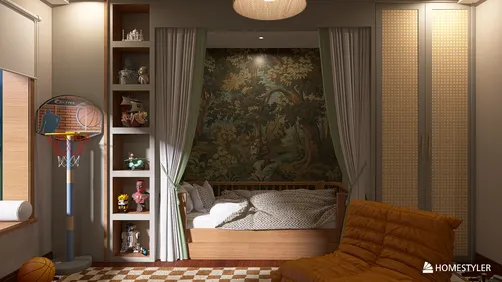
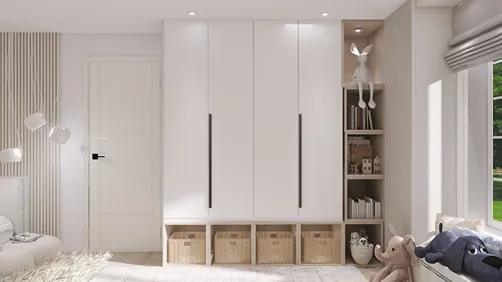
Child-Centered Interactive Space Design
The 'Child-Centered Interactive Space Design' refers to interior environments intentionally crafted to foster deep emotional connections, sensory engagement, and meaningful interaction between children and their surroundings. Unlike conventional functional spaces, this design paradigm prioritizes psychological safety, developmental appropriateness, and co-creation—transforming walls into memory carriers (e.g., rotating photo displays of family moments or child-made art), shelves into storytelling platforms, and floors into tactile exploration zones. Drawing from the Children’s Day Web Contest entries—including beach playgrounds, sensory gardens, pirate-themed bedrooms, and artist workshops—this scene synthesizes outdoor vitality, inclusive accessibility, narrative immersion, and personalized expression into a unified interior space planning philosophy.
Design Challenges and Common Pitfalls
Key challenges include balancing safety with creative freedom (e.g., avoiding sharp edges while preserving open-ended play), integrating evolving developmental needs (e.g., scaling furniture for growth without compromising aesthetics), and embedding interactivity without visual clutter. Common pitfalls involve over-personalization that limits adaptability, neglecting multisensory input (e.g., relying only on visuals while omitting texture, sound, or scent cues), and underutilizing vertical space for interactive storage or memory walls—especially critical in compact residential interiors where indoor space planning must maximize both function and emotional resonance.
✅ Prioritize Emotional Anchoring Through Personalized Memory Integration
Anchor the space emotionally by transforming everyday objects into living memory carriers: display rotating artwork on magnetic or pegboard walls, embed certificates in illuminated shadow boxes, or digitize family photos into QR-coded frames that link to voice-recorded stories. This transforms static décor into dynamic emotional touchpoints—reinforcing identity, belonging, and intergenerational connection.

Rebecca Laghi’s 'La bambina che ama leggere' masterfully applies this principle: her cozy reading nook features open wall shelves displaying the child’s own books and illustrated journals—not just decor, but curated self-expression. Using Homestyler’s AI design tools, she optimized shelf depth and height for small-space ergonomics while maintaining visual lightness—a hallmark of intelligent indoor space planning. The placement invites daily interaction, turning literacy into ritual and ownership into emotional anchoring.
Start Free Design✅ Embed Multisensory Zones for Holistic Development
Go beyond sight and touch: integrate layered sensory stimuli—textured wall panels (e.g., cork, woven rattan), scent-diffusing planters with lavender or mint, gentle wind-chime accents near windows, and acoustically softened zones using felted wall hangings or carpet tiles. These elements support neurodiverse learners and deepen environmental engagement through cross-modal feedback.

Irina Romanova 💫’s 'Creative workshop of a young artist' exemplifies multisensory integration: her mountain-themed wall combines bold color gradients (visual), raised contour lines (tactile), and implied scale (spatial cognition), while surrounding furniture—low stools, washable art carts, and adjustable task lighting—supports sustained creative flow. Leveraging Homestyler Design Tips, she simulated natural daylight angles to enhance pigment perception and used real-time 3D rendering to test circulation paths—ensuring seamless transitions between drawing, storing, and reflecting.
Begin Your Free Design✅ Design for Growth, Not Just Age
Anticipate physical, cognitive, and social evolution: choose modular furniture (e.g., loft beds with convertible desks), install height-adjustable wall systems for changing displays, and define zones with flexible boundaries (e.g., removable rug markers or acoustic curtains). This future-proofs the space—supporting toddlers’ motor play today and pre-teens’ collaborative projects tomorrow—without requiring renovation.

MS Design’s 'Pirateroom' embodies growth-oriented planning: the ship-shaped bed serves as imaginative shelter for early childhood, while its under-bed storage and integrated ladder double as organizational training tools. The treasure-map desk evolves into a study station with repositionable accessories; the interactive memory wall accommodates certificates, drawings, and future travel souvenirs. Using Homestyler’s parametric modeling, MS Design tested 12 layout iterations for scalability—proving how strategic indoor space planning enables lifelong relevance.
Launch Free DesignFAQ
Q: How does 'deep interaction' translate into practical interior space planning for children?
It means designing surfaces, furniture, and lighting not just for use—but for dialogue. A chalkboard-painted wall invites co-creation; a floor-to-ceiling photo timeline supports narrative development; recessed LED strips under shelves create 'discovery lighting' that rewards exploration—all core Homestyler Design Tips for emotionally intelligent environments.
Q: Can Homestyler AI tools help simulate developmental appropriateness before building?
Absolutely. Homestyler’s real-time 3D rendering allows designers to test sightlines from child-height perspectives, simulate natural light at different times (critical for circadian rhythm support), and validate reach ranges for interactive elements—turning theoretical child development principles into measurable spatial outcomes.
Q: What’s the most overlooked element in child-centered design—and how can it be addressed?
The transition zone—between active play, quiet reflection, and rest—is often neglected. Solutions include gradient flooring (carpet → cork → rubber), acoustic zoning with fabric-wrapped panels, and dual-purpose furniture (e.g., a beanbag that doubles as a reading nook and nap pod). These subtle shifts are essential for regulating attention and emotion—key goals of holistic indoor space planning.

Modern Solid Wood Velvet Fabric Dining Table and Armchair Set 3D Model

Modern Solid Wood Glass Top Storage Desk With Rattan Doors 3D Model
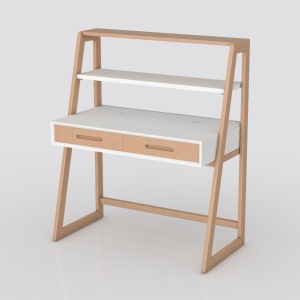
Minimalist Solid Wood Two Tone Writing Desk with Shelves 3D Model
Homestyler offers an easy-to-use online design tool with stunning 3D renderings, inspiring interior projects, and helpful DIY video tutorials. It’s perfect for anyone looking to create and visualize beautiful home designs effortlessly.
Projete agora para LIVRE