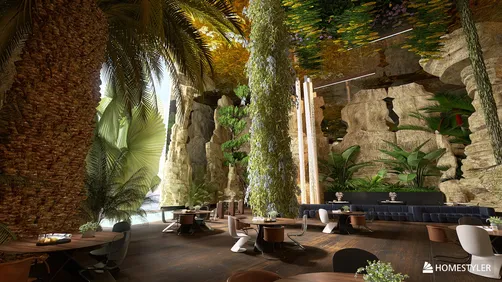
Cave-Inspired Dining Space Design
The 'Cave-Inspired Dining Space' is a conceptual interior design scenario that transcends literal geological formations. It refers to any dining environment—restaurant, lounge, or hybrid social eatery—where primal natural aesthetics (raw textures, organic contours, earthy palettes, and immersive biophilic elements) are intentionally fused with contemporary spatial planning and modern hospitality functionality. This scene prioritizes sensory storytelling: light becomes sculptural, materials tell geological time, and spatial flow mimics erosion paths—transforming dining into an experiential ritual rather than mere sustenance. It's not about replicating a cave, but evoking its emotional resonance—mystery, sanctuary, timelessness—through intelligent indoor space planning and atmospheric layering.
Design Challenges & Common Pitfalls
Designing a cave-inspired dining space presents unique challenges rooted in balancing authenticity with usability. Common issues include poor spatial hierarchy—leading to confusing circulation or acoustically harsh zones; overuse of heavy textures without contrast, causing visual fatigue; inadequate lighting strategy (e.g., relying solely on ambient glow without task or accent layers); and neglecting human-scale ergonomics beneath dramatic topography. Many designers also underestimate ventilation and climate control integration—especially critical when simulating enclosed, rock-like volumes—and fail to harmonize structural realism with ADA-compliant accessibility. These pitfalls directly impact guest comfort, operational efficiency, and the believability of the immersive narrative.
✅ Prioritize Biophilic Material Harmony
Select natural, tactile materials—not just visually stone-like, but sensorially rich: reclaimed wood, rammed earth panels, textured plaster, living moss walls, and hand-forged metal accents. Avoid synthetic imitations; instead, layer real organic textures to create depth and warmth. Use material contrast intentionally—e.g., smooth basalt floors against rough-hewn limestone columns—to guide movement and define zones. This principle supports holistic indoor space planning by grounding the experience in authenticity while enhancing acoustic absorption and thermal mass performance.

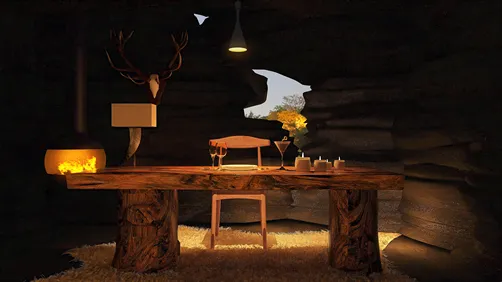
Irina Romanova 💫’s 'Restaurant "In the Dark"' masterfully applies Biophilic Material Harmony by juxtaposing raw cave-wall textures with warm, tactile wood furniture and soft textile drapery—even within a compact 33.6 m² layout. Using Homestyler Design Tips, she leveraged real-time material swatching and HDR lighting presets (moonlit_golf) to preview how aged oak and linen respond under candle-simulated illumination—proving that intimacy and texture can coexist without visual clutter.
Start Free Design✨ Sculpt Light as Architectural Medium
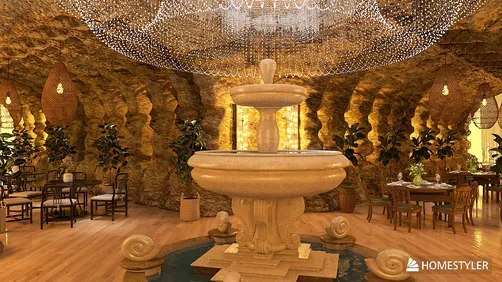
Lighting must function as both utility and narrative device. Layer ambient (soft cove or recessed), task (focused pendants over tables), and accent (grazing lights on textured walls or uplighting sculptural planters). Avoid uniform brightness; instead, embrace chiaroscuro—strategic shadows deepen perception of volume and add drama. Integrate smart controls for dynamic scenes (e.g., dusk-to-night transitions) and prioritize dimmable, warm-white LEDs (2700K–3000K) to reinforce organic warmth. This aligns with advanced Homestyler design techniques, where sunlight simulation and HDR environment mapping allow precise testing of luminance distribution before build.

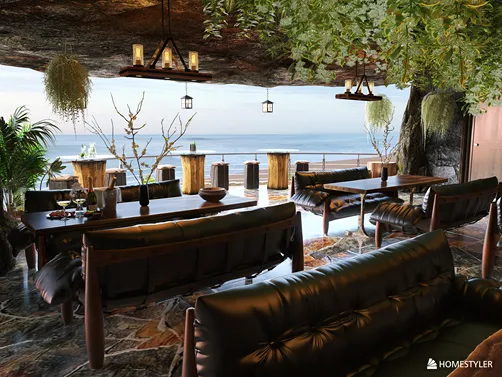
Julie Turner’s 'cave restaurant for web..' demonstrates Light-as-Medium mastery across a 222.8 m² oceanfront layout. She used Homestyler’s real-time sunlight slider and umhlanga_sunrise HDR to calibrate golden-hour glow through arched apertures—ensuring tables receive balanced 300 lux while wall textures retain dimensional shadow play. Her strategic use of recessed linear lighting along stepped floor levels subtly reinforces vertical rhythm, proving how lighting choreography elevates spatial legibility in complex cave-inspired topographies.
Begin Free Design🌿 Engineer Seamless Indoor-Outdoor Flow
Even in fully enclosed cave settings, psychological connection to nature is non-negotiable. Achieve this through sightlines (framed views via openings or mirrors), soundscapes (integrated water features or nature audio zoning), scent (living green walls, herb planters), and microclimate control (natural ventilation shafts or biophilic HVAC grilles). Use curved partitions, terraced flooring, and graduated planting—from moss carpets to soaring fern canopies—to blur thresholds. This principle strengthens indoor space planning by transforming static rooms into evolving ecological sequences.

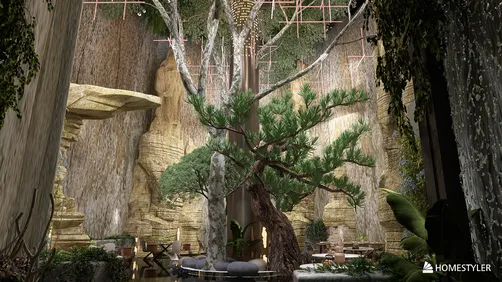
anjaa mmm’s 'CAVE' exemplifies Indoor-Outdoor Flow engineering in a zero-area-reported (conceptual) layout—likely leveraging Homestyler’s terrain modeling tools to embed native flora into rock fissures and extend dining platforms into cliffside vistas. Her use of organic-shaped tables and soft greenery isn’t decorative; it’s functional wayfinding and thermal buffering. By assigning specific plant species (visible in foliage density and height variation) and linking them to real-time wind/sun path simulations in Homestyler, she ensures ecological coherence—not just aesthetic mimicry.
Launch Free DesignFAQ
Q: How do I balance ‘primal cave aesthetics’ with modern accessibility and safety standards?
Always begin with code-compliant circulation widths (min. 914 mm clear path), non-slip floor finishes (textured stone composites, not polished slate), and integrated emergency lighting routed within architectural seams—not surface-mounted. Use Homestyler Design Tips to run ADA compliance checks during layout iteration, and simulate egress paths under low-light conditions using custom HDR environments.
Q: Can I realistically model irregular cave geometry in Homestyler without advanced CAD skills?
Absolutely. Homestyler’s freeform wall tool, terrain extrusion, and mesh import (OBJ/FBX) support organic shapes. Top winners like Rutchevelle Den Ouden used multi-level stairs and mezzanines—not flat slabs—to imply geological strata. Combine ‘Sculpt Mode’ with real-time section cuts to validate headroom and spatial hierarchy before rendering.
Q: What’s the most common mistake when applying ‘natural materials’ in cave-inspired spaces?
Overloading texture without tonal or thermal contrast—e.g., all matte, cool-toned stone creates visual monotony and acoustic echo. The fix: introduce warm wood accents, fabric upholstery, or metallic highlights (copper, brushed brass) to break repetition. Use Homestyler’s material library filters (‘Natural’, ‘Warm’, ‘Textured’) to rapidly test harmony across lighting scenarios.
Q: How does lighting design impact perceived space in cave-inspired interiors?
Strategic lighting expands perceived volume: grazing lights emphasize wall relief (making surfaces feel deeper), upward accent lights lift ceilings, and downward task lights anchor activity zones. In Homestyler, toggle ‘Sunlight Intensity’ and ‘HDR Environment’ simultaneously to observe how g_ljz_day vs. moonlit_golf transforms spatial psychology—even in identical geometry.

Modern Minimalist Leather Metal Armchair 3D Model

Minimalist Rattan Solid Wood Round Dining Table Set 3D Model
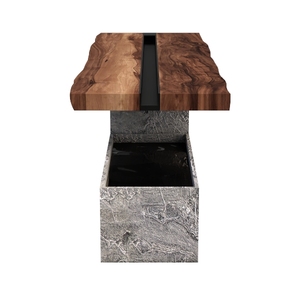
Rustic Live Edge Solid Wood Concrete Console Table 3D Model
Homestyler is a user-friendly online platform offering powerful home design tools, stunning 3D renderings, inspiring design projects, and helpful DIY video tutorials—perfect for bringing your interior design ideas to life effortlessly.
Projete agora para LIVRE