The 'Emotion-First Children's Space' Style Explained
The Children’s Day for Web contest centers on 'deep interaction'—a design philosophy that prioritizes emotional resonance over aesthetics alone. This style is not defined by a rigid palette or fixed layout, but by its intentional architecture of feeling: spaces are crafted to invite memory-making, spark imagination, and foster secure attachment through sensory-rich, child-led interactions. It merges psychological insight with spatial storytelling—transforming walls into memory galleries, furniture into adventure props, and light into mood conductors. Whether in a compact bedroom or an open-air playground, the core metric is not square footage, but the number of smiles, stories, and spontaneous 'I made this!' moments it inspires.

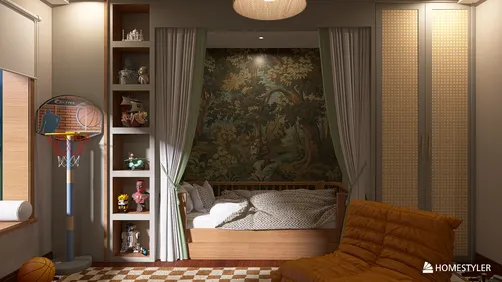
Featured work: rossella C.'s 'Kids room'. In Homestyler, this emotion-first style is achieved instantly via Smart Zones and Mood Lighting presets—simply drag a 'memory wall' component, upload child artwork as textures, and apply the 'Sunlit Garden' HDR for warm, inviting ambiance. All assets are pre-optimized for real-time 3D rendering, enabling designers to iterate on emotional impact—not technical constraints.
Start Free Design Now🎨 Emotional Color Psychology
This style uses color not decoratively, but therapeutically. Primary palettes are intentionally low-saturation and high-luminance (e.g., shell-white ceilings, sand-beige walls) to reduce visual stress and create calm backdrops. Accent hues—like coral, sky blue, or forest green—are introduced only at child-eye level (on furniture, textiles, or interactive elements) to guide focus and trigger joyful associations without overwhelming. The result is a chromatic hierarchy where emotion is *invited*, not imposed.
rossella C.'s 'Kids room' exemplifies this: soft beige walls recede visually, while the vibrant yellow sofa and leafy green plants become joyful focal points at toddler height. In Homestyler, designers replicate this instantly using the 'Palette Sync' tool—select a base neutral, then auto-generate emotionally aligned accents from the Child Development Color Library, all rendered in real time.
Begin Your Free Design🧩 Zoned Interaction Architecture
Rather than generic 'play zones', this style defines purpose-driven micro-environments: a 'Story Nook' (acoustic-absorbing, low-light), a 'Creation Corner' (height-adjustable, tool-accessible), a 'Memory Wall' (modular frames with tactile inserts), and a 'Calm Cove' (curved seating, weighted textiles). Each zone has distinct scale, texture, lighting, and acoustics—designed to support neurodiverse needs and evolving developmental stages.

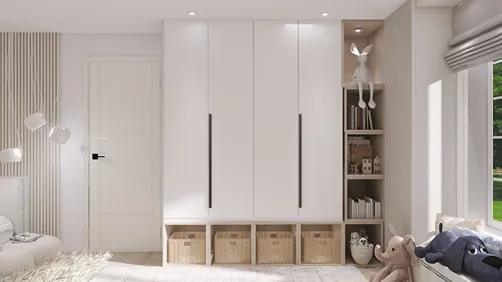
Галина Ясковець’s unnamed design (Ukraine) demonstrates precise zonal layering: a reading nook with pouf and soft lamp, a drawing desk with accessible storage, and a memory board above the bed—all scaled for a 5-year-old. In Homestyler, use the 'Zone Builder' plugin to drop pre-configured interactive zones with one click; adjust dimensions, materials, and lighting per zone—no manual modeling required.
Launch Free Design📜 Tactile Memory Integration
Objects aren’t merely decorative—they’re emotional anchors. Hand-drawn art becomes framed wallpaper; certificates transform into 3D-printed shelf brackets; fabric swatches from baby clothes line drawer interiors. Texture variety (rough rope, smooth ceramic, nubby wool) is layered deliberately to stimulate proprioception and reinforce autobiographical memory—turning the room into a living storybook.

MS Design’s 'Pirateroom' (France) transforms memory integration into narrative play: a treasure chest doubles as toy storage, hand-drawn maps become wall decals, and rope textures wrap bedposts. In Homestyler, upload child artwork directly into the Texture Studio, convert sketches to embossed wall panels or custom decals in one click—and preview tactile depth and lighting interaction in real-time 3D.
Create Free DesignFAQ
Q: What does 'deep interaction' mean in this contest context?
A: It means designing spaces where children don’t just occupy a room—they co-author it. A photo wall isn’t static decoration; it’s a rotating gallery where kids curate their own milestones. A bookshelf isn’t just storage—it’s a climbable landscape with hidden compartments for drawings. Every element invites touch, choice, and personal meaning.
Q: Can I submit designs for outdoor spaces like playgrounds?
A: Yes! As seen in Amy ✨’s Top 1 winning beach playground, outdoor environments are fully eligible. Focus on how natural elements (sand, water, shade) and built features (swings, slides, sensory paths) collaborate to spark social connection, physical confidence, and unstructured joy.
Q: How does Homestyler support creating emotionally resonant children’s spaces?
A: Homestyler provides specialized tools: the 'Child-Scale Preview' mode (switches camera height to 1m), 'Mood Lighting Presets' (calm, playful, focus), and the 'Memory Wall Generator'—upload images, and it auto-creates printable frames, textured panels, or AR-enabled digital displays—all rendered photorealistically in real time.

Modern Two Tone Solid Wood Kids Bookshelf Storage 3D Model

Modern Minimalist Two Tone Open Bookshelf 3D Model

Minimalist White Solid Wood Storage Cabinet 3D Model
Homestyler is an easy-to-use online home design platform offering powerful 3D rendering tools, a vast collection of interior design projects, and helpful DIY video tutorials—perfect for bringing your home design ideas to life quickly and creatively.
Projete agora para LIVRE