Cave Restaurant Design Style Decoded
The 'Cave Restaurant' design style—born from Homestyler’s global Web Design Challenge—reimagines dining as a primal-sensory ritual. It is not merely about mimicking geological forms, but about orchestrating a profound dialogue between raw nature and refined modernity. At its core lies the concept of *cave as canvas*: irregular rock walls become sculptural backdrops; natural light (or its evocative absence) transforms into a dynamic design element; and organic materials—stone, wood, clay, living greenery—are deployed not as decoration, but as narrative agents. This style rejects sterile minimalism in favor of layered authenticity: textures are tactile, contrasts are intentional (rough vs. smooth, dark vs. luminous), and spatial flow embraces the cave’s inherent asymmetry. It is architecture that breathes, interiors that invite contemplation, and hospitality that feels elemental.

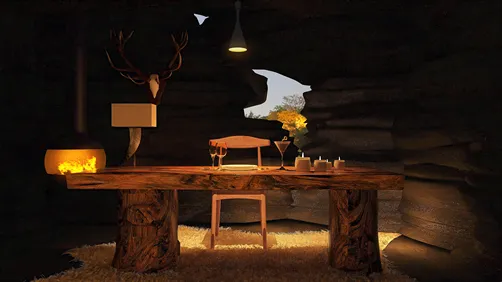
Restaurant "In the Dark" by Irina Romanova 💫
Design Your Cozy CaveThis award-contending design masterfully leverages Homestyler’s real-time 3D rendering to evoke total immersion: the absence of windows is not a limitation, but a feature. By using Homestyler’s HDR lighting presets (like 'moonlit_golf') and precise sunlight control (sunlight: 0), designers can craft profound chiaroscuro effects—where candlelight becomes the sole protagonist, dancing on textured stone. The software’s intuitive material library allows instant application of rough-hewn stone and warm, aged wood finishes, while its smart object placement ensures furniture integrates organically into uneven surfaces. With Homestyler, translating this atmospheric, emotionally charged vision from concept to photorealistic render is seamless and intuitive.
Primal Texture & Material Authenticity 🪨
The foundation of the Cave Restaurant style is an unflinching celebration of raw, unrefined materiality. Smooth plaster or glossy tile is antithetical; instead, designers prioritize surfaces with inherent character: rough-hewn limestone walls, exposed bedrock formations, charred timber (shou sugi ban), hand-troweled clay plasters, and porous travertine floors. These are not merely 'finishes'—they are geological signatures. Their value lies in their imperfections: fissures, grain variations, subtle color shifts, and tactile depth. This texture creates visual weight, acoustic warmth, and a powerful sense of place, grounding the modern interventions firmly in the earth.

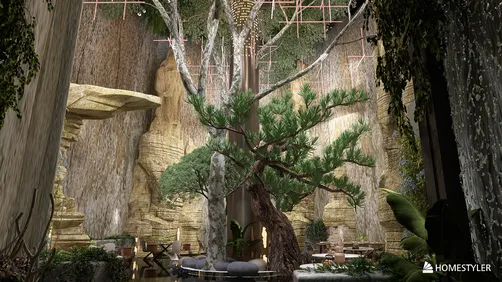
CAVE by anjaa mmm
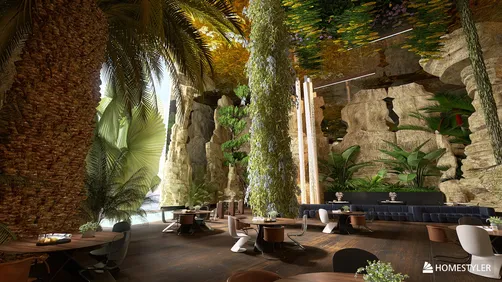
Craft Your Natural EscapeThis Top 3 winner demonstrates how Homestyler empowers designers to treat texture as the primary design language. The massive, undulating rock wall isn’t hidden—it’s the star. Using Homestyler’s advanced surface editor, the designer applied a custom, high-resolution stone texture map with precise bump and roughness settings, creating a deeply convincing sense of geological age and mass. The integration of live greenery—softening the hard edges—is achieved through Homestyler’s robust plant library and realistic shadow-casting tools, ensuring the foliage interacts authentically with the stone’s contours. In Homestyler, achieving this level of textural fidelity requires no external software—just intuitive drag-and-drop and real-time visual feedback.
Organic Spatial Flow & Asymmetrical Layout 🌊
A true cave is never a perfect rectangle. The Cave Restaurant style rejects rigid grids and symmetrical axes in favor of fluid, experiential circulation. Pathways meander, ceilings vault unpredictably, and seating areas nestle into natural alcoves or cascade down gentle, terraced levels. This organic flow is designed to encourage discovery and slow down time—guests move from dimly lit arrival zones into brighter, more open dining chambers, creating a journey rather than a static room. Furniture is often custom-shaped or arranged in free-form clusters, reinforcing the sense of a space discovered, not constructed.

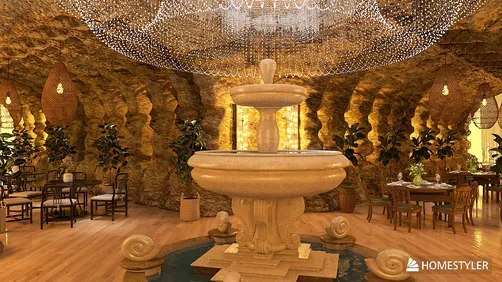
Chill Spot Oasis by Safiya Edwards
Shape Your Organic FlowThis Creative Award-winning design exemplifies Homestyler’s power in modeling complex, non-Euclidean spaces. The cavernous volume—with its soaring, irregular ceiling and integrated pool—is built using Homestyler’s flexible wall and ceiling tools, which allow for curved, sloped, and multi-level geometries. The 'flower ceiling' effect is achieved not with a single texture, but by strategically placing hundreds of individual 3D floral models from Homestyler’s extensive library, each casting its own soft shadow. The result is a breathtaking, biophilic environment where architecture and nature are inseparable—a feat made accessible and efficient within Homestyler’s unified platform.
Atmospheric Light & Strategic Contrast 🌙
Light is the most critical and expressive tool in the Cave Restaurant palette. It is rarely uniform or overhead. Instead, it is intimate, directional, and often mysterious: focused pools of light from recessed floor spots, warm glows emanating from behind stone slabs, flickering candlelight reflected off water features, or dramatic shafts of daylight piercing through a high, narrow aperture. This strategic use of light creates deep shadows, highlights textural richness, and sculpts the space, transforming it from a simple room into a theatrical, ever-changing experience. The interplay of light and dark is not incidental—it is the core dramaturgy of the design.

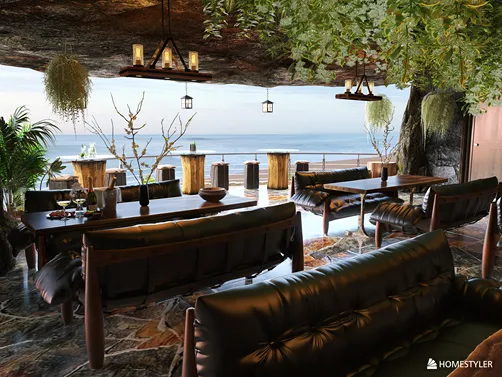
DUNA by Susan Pimentel
Build Your Oasis LoungeDUNA’s desert cave aesthetic is defined by its masterful manipulation of light and contrast, perfectly realized in Homestyler. The design uses the 'g_fallen_leaves' and custom HDR environments to bathe the warm-toned stone in a soft, golden-hour glow, while keeping deeper recesses in rich, velvety shadow. Homestyler’s real-time lighting engine allows the designer to instantly preview how different light sources interact with complex surfaces—seeing how light catches the edge of a carved stone table or diffuses through a sheer textile canopy. This immediate, photorealistic feedback loop makes crafting such nuanced, mood-driven atmospheres not just possible, but highly efficient within the Homestyler ecosystem.
FAQ
Q: What is the core philosophy behind the 'Cave Restaurant' design style?
It’s about forging a primal-sensory connection between diners and the environment. It merges raw, ancient geological elements (stone, earth, darkness) with sophisticated, modern design (lighting, furniture, spatial choreography) to create a space that feels both timeless and utterly contemporary—a sanctuary where taste and sight are experienced as one unified, elemental feast.
Q: How does Homestyler specifically support the creation of this style?
Homestyler provides the essential toolkit: a vast library of ultra-realistic natural textures (stone, wood, clay), an advanced, real-time HDR lighting system for crafting dramatic atmospheres, flexible modeling tools for non-rectangular, organic spaces, and an extensive catalog of biophilic elements (plants, water features). Its intuitive interface allows designers to focus on creative storytelling, not technical hurdles.
Q: Are there any common pitfalls to avoid when designing in this style?
Avoid over-cluttering with too many competing textures or styles. The power lies in restraint and authenticity—let the stone be the hero, not a backdrop for excessive ornament. Also, beware of poor lighting planning; without careful layering of light sources, a cave space can easily feel oppressive or flat, rather than mysterious and inviting.
Homestyler offers an easy-to-use online home design tool with stunning 3D renderings, a vast collection of design projects, and helpful DIY video tutorials. It’s perfect for anyone looking to creatively plan and visualize their interior spaces with confidence.
Projete agora para LIVRE