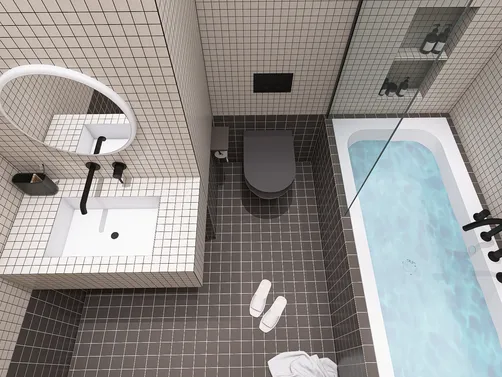
Grid-Patterned Living Space Design
The 'Grid-Patterned Living Space' refers to a contemporary interior design approach where geometric grid logic—manifested through flooring, wall paneling, ceiling modules, furniture layouts, or material repetition—structures the spatial experience. It is not merely decorative tiling, but a holistic organizational principle that harmonizes order and innovation. As demonstrated in the Homestyler Grid-Patterned Space for Web contest, top-winning entries applied grids to living rooms, kitchens, bathrooms, and studios—not as rigid constraints, but as frameworks for rhythm, proportion, and visual calm. This scene prioritizes clarity of form, intentional alignment, and layered geometry while preserving warmth, functionality, and human scale—making it ideal for modern apartments, compact homes, and digitally native design workflows using Homestyler AI tools.
Design Challenges & Common Pitfalls
Designers often struggle with over-rigid interpretation: turning grids into monotonous repetition rather than dynamic composition. Key challenges include visual monotony from uniform spacing, loss of spatial hierarchy when all elements align equally, difficulty integrating organic forms (e.g., curved sofas or free-form lighting) without breaking continuity, and poor scalability—where grid logic fails across varying room sizes or ceiling heights. Additionally, many overlook lighting and material transitions, causing grid lines to visually 'disconnect' under real-world illumination—especially critical when rendering with Homestyler’s real-time 3D engine.
✅ Grid-Based Spatial Hierarchy
A strong grid should guide attention—not flatten it. Use proportional variation (e.g., 2:1 or 3:2 module ratios) and strategic breaks (a single offset tile, a floating shelf interrupting a wall grid) to establish focal zones—such as a fireplace wall or reading nook—while maintaining overall coherence. Avoid equal subdivision; instead, layer grids (e.g., floor tile grid + ceiling beam grid + furniture footprint grid) at complementary scales.

Encarni Fernandez Calero’s 'Apartamento centro ciudad' masterfully applies spatial hierarchy via a layered grid system: the herringbone wood floor establishes base rhythm, while aligned cabinetry and recessed ceiling lighting create vertical cadence. Crucially, the fireplace wall breaks symmetry with an asymmetric stone module—yet remains anchored by shared grid intervals. Using Homestyler’s Smart Furniture Arrangement and real-time sunlight simulation, she tested how shadow fall reinforced (rather than disrupted) the grid logic—proving that hierarchy emerges from *controlled variation*, not uniformity.
Start Free Design✅ Material-Driven Grid Continuity
Grids gain depth and warmth when materials—not just lines—carry the pattern. Choose textures, grain directions, or finish variations (e.g., matte vs. gloss tiles, vertical vs. horizontal wood grain) that echo the underlying grid without literal replication. This supports indoor space planning by reinforcing boundaries and flow paths while avoiding visual fatigue. Always preview material transitions in different lighting conditions— Homestyler’s HDR environment presets (e.g., 'north_euro_city') are essential for validating continuity.

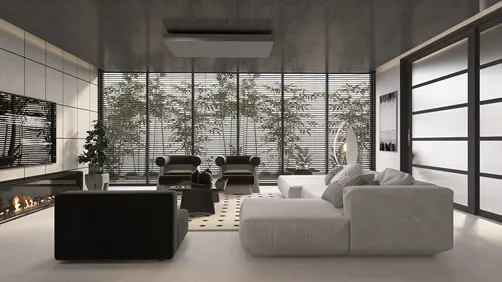
Susan Pimentel’s 'Diseño Japandi con Tonos de Madera Fría' achieves material-driven continuity by unifying floor, wall, and ceiling through directional grain: horizontal oak flooring, vertically slatted wall panels, and linear ceiling beams—all sharing identical module widths. The soft Japandi palette prevents contrast overload, while Homestyler’s texture-mapping tools allowed her to simulate how light interacts with each surface’s micro-relief—ensuring the grid feels tactile, not graphic. This exemplifies intelligent indoor space planning: structure is felt before it’s seen.
Design Your Cozy Space✅ Adaptive Grid Scaling
A successful grid adapts across dimensions—large walls use macro-modules (e.g., 60×60 cm tiles), while small surfaces (backsplashes, drawer fronts) employ micro-grids (e.g., 15×15 cm). Maintain consistent mathematical relationships (e.g., all modules divisible by 15 cm) so elements feel like parts of one system. In open-plan spaces, extend grid logic across zones—e.g., kitchen cabinet spacing mirrored in adjacent living room shelving—to unify multi-functional areas without physical dividers.

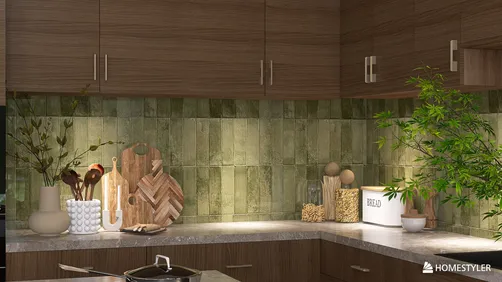
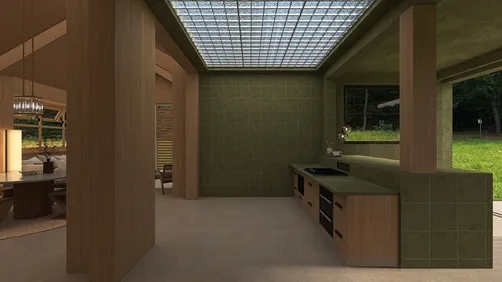
Greyvalley Studios’ 'Shikoku Stillness' demonstrates adaptive scaling flawlessly: large-scale lattice room dividers (120×120 cm modules) define the entry zone, while the kitchen backsplash uses 15×15 cm green ceramic tiles—exactly 1/8th the linear dimension—creating rhythmic harmony. Homestyler’s parametric modeling enabled instant scaling adjustments: changing one module updated all linked components (cabinets, tiles, lighting positions), ensuring zero misalignment. This is core Homestyler design技巧: grids become living systems—not static drawings.
Create Your Japandi StyleFAQ
Q: Do I need professional drafting skills to apply grid patterns effectively in Homestyler?
Not at all. Homestyler’s Smart Grid Assist and Auto-Snap features automatically align objects to customizable grid intervals—even during drag-and-drop placement. Beginners can start with preset 30 cm or 60 cm grids and refine later using Measurement Mode.
Q: Can grid-patterned designs work in irregularly shaped rooms?
Absolutely. Top winners like Rutchevelle Den Ouden’s 'BWG' used diagonal grid overlays and rotated module arrays to resolve awkward angles— Homestyler’s Rotate & Clone tool makes this intuitive. The key is anchoring the grid to primary sightlines (e.g., view from doorway), not wall edges.
Q: How do I avoid making my grid design look 'cold' or institutional?
Introduce warmth through layered grids: combine structural (ceiling beams) with textural (wood grain direction) and chromatic (tonal gradients in tile batches). As seen in Anna Poikalainen’s black/white bathroom, subtle grout width variation and warm LED lighting simulated by Homestyler’s 'g_ljz_day' preset add humanized depth.
Q: Is grid-based interior space planning suitable for small apartments?
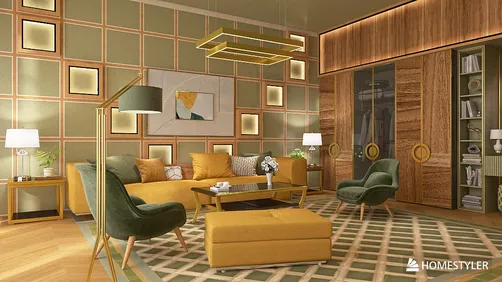
Yes—especially for small apartments. Grid logic maximizes perceived space by reinforcing clean sightlines and reducing visual clutter. Nadya P’s yellow-green living room (48 m²) used a 40 cm floor grid to coordinate furniture, lighting, and artwork placement—achieving spaciousness without square footage. Homestyler’s Room Resize tool lets you test grid adaptability across multiple layouts instantly.


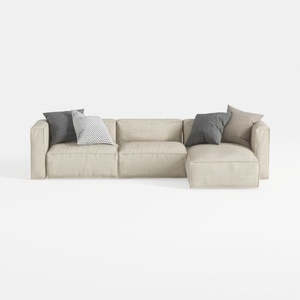
Minimalist Fabric L Shaped Sectional Sofa with Throw Pillows 3D Model
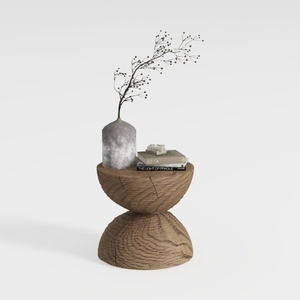
Minimalist Solid Oak Wood Side Table Unique Hourglass Shape 3D Model
Homestyler is an easy-to-use online home design platform offering powerful 3D rendering, a vast collection of interior design projects, and helpful DIY video tutorials—perfect for bringing your home ideas to life with confidence and creativity.
Projete agora para LIVRE