Grid-Patterned Design Decoded: Geometry, Order & Innovation
The 'Grid-Patterned Space for Web' challenge celebrates a design philosophy rooted in precision, rhythm, and intentional restraint. Far more than simple tile layouts or floor patterns, grid-based design is a holistic spatial language — one that governs proportion, alignment, hierarchy, and visual breathing room. It draws inspiration from architectural blueprints, Japanese shoji screens, modular furniture systems, and even digital UI grids, translating mathematical clarity into human-centered environments. This style embraces modernity not through ornamentation, but through intelligent structure: walls align with cabinet edges, lighting fixtures follow ceiling joist intervals, and furniture groupings obey invisible axes — all to evoke calm, coherence, and effortless functionality. In Homestyler’s real-time 3D rendering environment, designers leverage smart snap-to-grid tools, modular asset libraries, and parametric wall/floor systems to build these disciplined yet expressive spaces with unprecedented speed and fidelity.

Emma LA’s 'Omnia' demonstrates how grid logic elevates wellness spaces: the yoga mat anchors the center axis, the running machine aligns flush with the wall grid, and pendant lights hang at equidistant intervals — all rendered seamlessly in Homestyler’s 4K real-time 3D engine. With just a few clicks, users can enable grid snapping, import modular gym equipment from the Homestyler asset library, and adjust sunlight parameters to preview how light interacts with aligned surfaces — proving that discipline and serenity are built, not decorated.
Start Free Design NowGeometric Precision: Where Lines Meet Intention
At its core, grid-patterned design relies on strict adherence to orthogonal lines and consistent spacing modules. This isn’t about rigidity — it’s about establishing visual trust. Walls, cabinetry, flooring joints, and even artwork placement are consciously aligned along shared horizontal and vertical axes. The result is an environment where the eye moves effortlessly, without visual friction; every element feels purposefully placed, not arbitrarily arranged. This structural honesty supports both minimalist aesthetics and functional clarity — especially critical in compact urban apartments or multi-use rooms.

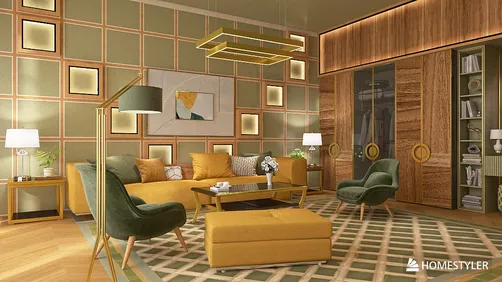
Vanessa Ribeiro’s 'Espaço Harmonioso e Geométrico' masterfully unifies living and kitchen zones using a continuous grid floor pattern as the foundational rhythm. Straight-edged cabinetry mirrors wall lines, and open shelving units echo the same module width — creating flow without physical barriers. In Homestyler, this is achieved instantly: select 'Grid Floor' under Materials, activate 'Snap to Grid' in the toolbar, then drag-and-drop cabinets from the 'Modern Modular Kitchen' collection — all automatically aligning to the underlying 30cm structural grid.
Design Your Grid SpaceMonochromatic Harmony: Color as Structural Element
Grid-based interiors often adopt restrained palettes — primarily black, white, grey, and warm neutrals — to avoid competing with the geometry itself. Color here serves a compositional role: defining planes (e.g., black baseboards anchoring walls), highlighting alignment (e.g., matching cabinet handles and door pulls), or introducing subtle contrast (e.g., charcoal grout lines against white subway tile). This tonal discipline ensures the grid remains legible and dominant, while still allowing warmth and tactility through material variation — like matte black metal against bleached oak or textured concrete.

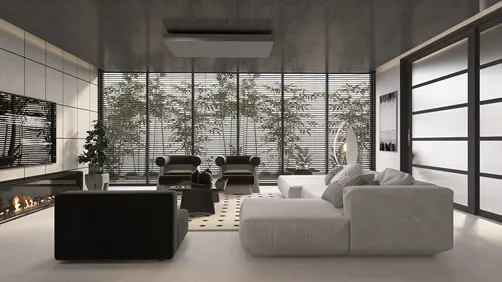
Rutchevelle Den Ouden’s 'BWG' (Black, White, Grey) is a textbook study in chromatic restraint — where color becomes architecture. Every surface, from rug borders to sofa piping and ceiling beams, adheres to the three-tone system, reinforcing spatial divisions without walls. In Homestyler, designers achieve this cohesively by using the 'Material Sync' feature: apply a single grey tone to walls, then sync it across trim, flooring grout, and upholstery — ensuring perfect tonal harmony across all 3D views and renders.
Create Modern Living NowTextural Layering: Depth Without Distraction
Since grid design minimizes visual noise, texture becomes the primary vehicle for depth and sensory richness. Smooth lacquered cabinetry contrasts with hand-troweled plaster walls; linear wood grain runs parallel to floor joints; woven rattan pendants cast rhythmic shadows aligned with ceiling grid lines. These tactile variations honor the grid’s order while adding warmth, authenticity, and human scale — preventing sterility and inviting touch. Texture is never random; it’s calibrated, repeated, and always subordinate to the underlying geometric framework.

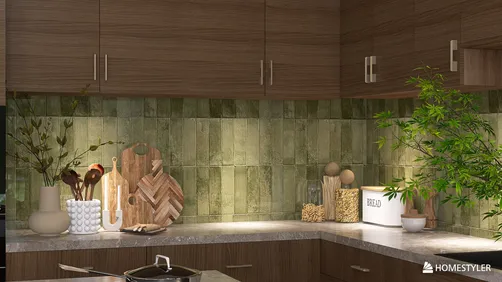
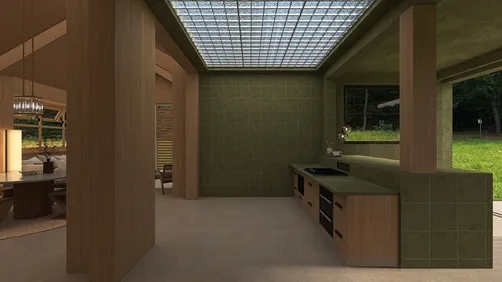
Greyvalley Studios’ 'Shikoku Stillness' exemplifies textural intelligence: green ceramic tiles repeat in a tight grid, their glossy surface reflecting cedar ceiling slats laid in identical spacing — a dialogue of material and geometry. Woven screen-like walls introduce organic rhythm *within* rigid framing. In Homestyler, this is realized via the 'Texture Tiling' slider: set tile repetition to match your grid module (e.g., 30cm), then apply complementary textures to adjacent surfaces — all previewed in real time with accurate light bounce and shadow casting.
Launch Your Living DesignFAQ
Q: What does 'grid-patterned space' mean in interior design?
A: It refers to a design methodology where spatial organization, furniture placement, material joints, and decorative elements are intentionally aligned to a consistent orthogonal grid — prioritizing order, proportion, and visual cohesion over free-form composition.
Q: Can I create grid-based designs in Homestyler without advanced modeling skills?
A: Absolutely. Homestyler offers intuitive grid-snapping, pre-scaled modular furniture sets, auto-align tools, and one-click floor/wall material tiling — enabling precise grid layouts in minutes, not hours.
Q: Are grid-patterned interiors only suitable for modern or minimalist styles?
A: No — the grid is a foundational system adaptable to Japandi, Scandinavian, industrial, or even transitional aesthetics. As seen in top entries like Susan Pimentel’s 'Japandi with Cool Wood Tones', the grid provides structure while materials and textures define character.
Q: How do I ensure my grid design looks balanced and not sterile?
A: Introduce warmth through natural materials (wood, stone, linen), vary texture within the grid (e.g., smooth cabinets + ribbed wallpaper), and use lighting to cast deliberate shadows that reinforce the grid rhythm — all easily adjustable in Homestyler’s real-time lighting controls.
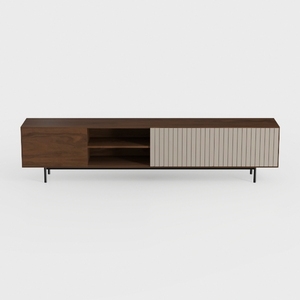
Modern Minimalist Walnut Cane TV Stand With Open Storage 3D Model
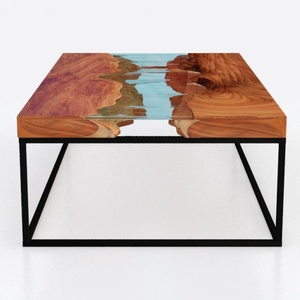
Modern Solid Wood Epoxy Resin Square Coffee Table 3D Model
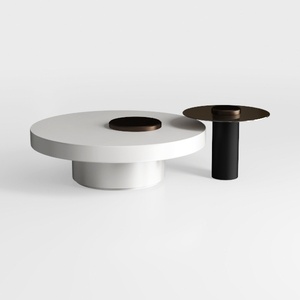
Modern Minimalist Round Nesting Coffee Tables Solid Wood Metal 3D Model
Homestyler offers an easy-to-use online design tool, stunning 3D renderings, and a vast collection of design projects. With helpful DIY video tutorials, it’s a fantastic platform to visualize and create your dream home effortlessly.
Projete agora para LIVRE