Home Fitness Integration Design
This design scene refers to the seamless integration of fitness functionality into everyday living spaces—such as living rooms, bedrooms, balconies, or even compact apartments—without sacrificing aesthetics or spatial efficiency. Rather than relegating exercise equipment to a dedicated, isolated 'gym room,' the concept transforms furniture and architectural elements into dual-purpose assets: a yoga mat doubles as a textural rug; a wall-mounted resistance tower blends with shelving; a foldable treadmill tucks beneath a console table; and balcony railings double as pull-up bars. Rooted in human-centered interior space planning, this approach prioritizes lifestyle continuity—making movement intuitive, joyful, and embedded in daily rituals like morning coffee, evening wind-downs, or family playtime.
Design Challenges & Common Pitfalls
Designing for home fitness integration presents unique spatial, ergonomic, and aesthetic hurdles. Key challenges include: (1) reconciling equipment scale and safety clearances with tight urban footprints; (2) mitigating visual clutter from gear while preserving functional accessibility; (3) balancing acoustic privacy (e.g., treadmill noise, dropped weights) in open-plan or multi-use zones; (4) ensuring long-term adaptability as fitness goals or household needs evolve; and (5) avoiding sterile 'gym-like' atmospheres that clash with residential warmth—especially critical in shared or multi-generational homes.
✅ Principle 1: Furniture-First Fitness
Treat fitness tools not as standalone appliances but as integral, aesthetically cohesive furniture pieces. Prioritize modular, low-profile, and visually refined equipment—such as wall-mounted fold-away racks, upholstered yoga platforms, or weight benches disguised as ottomans. This principle supports flexible interior space planning by enabling quick reconfiguration and maintaining visual calm—even when gear is in use.

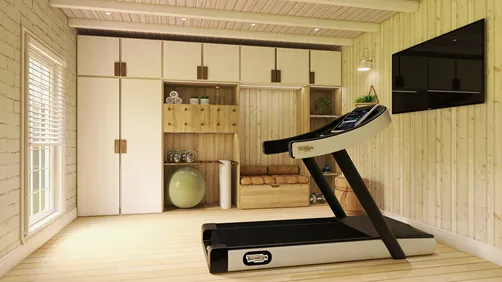
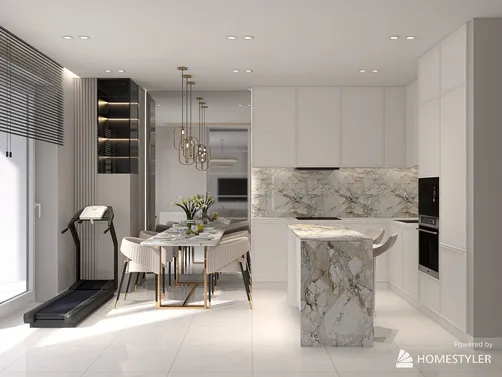
Afrah Alwy’s 'Home Gym' masterfully applies the Furniture-First Fitness principle: she anchors the space with a sleek, low-profile treadmill positioned flush against a window wall—framed like built-in millwork—not a freestanding machine. Dumbbells are stored vertically in a custom walnut rack mimicking bookshelves, while yoga mats roll neatly into a woven basket beside a linen-upholstered bench. Using Homestyler AI design tools, she simulated natural light flow and tested multiple layout iterations to ensure 1.2m clearance around all active zones—showcasing how smart interior space planning and Homestyler design techniques harmonize function and serenity.
Start Free Design Now🌿 Principle 2: Biophilic Movement Zones
Anchor fitness activity in nature-connected environments—leveraging daylight, greenery, views, and organic materials—to reduce perceived exertion and enhance mental recovery. Integrate large windows, indoor plant walls, water features, natural wood finishes, and earth-toned textiles. These biophilic cues lower cortisol, improve focus during Pilates or meditation, and make sustained home-based movement psychologically sustainable.

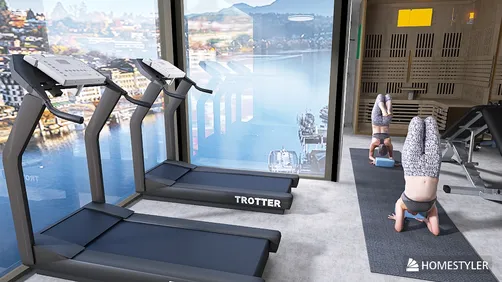
Hilola Mamadhanova’s 'терраса' (terrace) exemplifies Biophilic Movement Zones: she situates a compact treadmill directly adjacent to sliding glass doors opening onto lush greenery, with an ocean vista visible beyond. A sculptural bamboo stool and hanging ferns reinforce the outdoor-indoor continuum, while Homestyler’s real-time 3D rendering allowed her to test sun angles across seasons—ensuring optimal morning light without glare on the treadmill display. Her work demonstrates how Homestyler design techniques elevate biophilic interior space planning from concept to calibrated reality.
Begin Free Design Today🎨 Principle 3: Adaptive Visual Hierarchy
Use color, texture, lighting, and zoning—not physical barriers—to subtly demarcate fitness zones within open layouts. Apply a consistent material palette (e.g., warm oak floors + matte black fixtures), employ strategic accent lighting over key activity areas (e.g., focused LED strips above yoga corners), and introduce playful yet cohesive color accents only where movement occurs—transforming functional zones into intentional, joyful design moments rather than utilitarian afterthoughts.

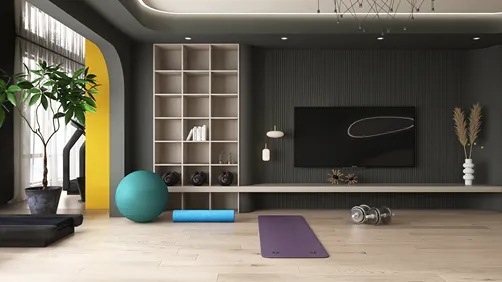
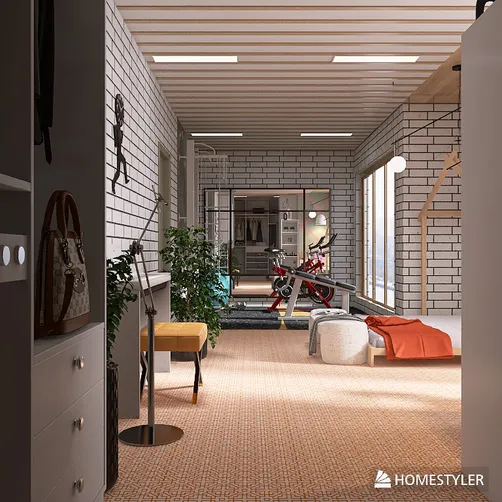
Miyako Noda’s 'colourful fitness room' brilliantly deploys Adaptive Visual Hierarchy: she uses saturated coral and teal accents exclusively on the stationary bike frame, wall-mounted resistance bands, and floor cushions—while keeping walls, ceiling, and storage units in soft white and pale oak. This creates instant visual recognition of the ‘active zone’ without segmentation. With Homestyler AI, she rapidly prototyped 12 color combinations and validated contrast ratios for accessibility—proving how Homestyler design techniques empower precise, inclusive interior space planning for diverse users, including children.
Try Free Design OnlineFAQ
Q: Can I integrate fitness equipment into a small apartment without making it look like a gym?
Yes—by adopting furniture-first strategies (e.g., foldable wall units, ottoman-weight storage) and leveraging Homestyler design techniques to simulate spatial flow and scale. Top-winning entries like Viktoriia V’s award-winning 'fitness' design prove that even 42 m² can host full-body training with zero visual dominance.
Q: How do I choose the right location for a home fitness zone?
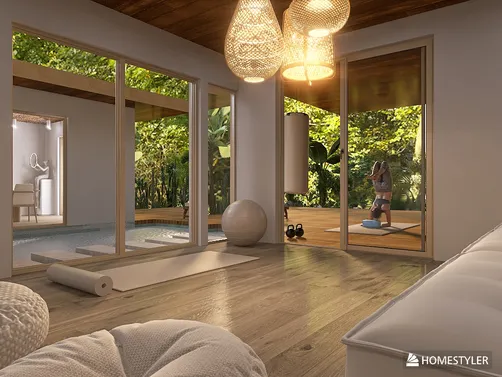
Prioritize access to natural light and ventilation—living rooms with large windows, balconies with city/green views, or quiet bedroom corners are ideal. Avoid high-traffic hallways or acoustically sensitive areas (e.g., next to bedrooms). Alice Bresolin’s 'A Zen Villa' shows how orientation and daylight simulation in Homestyler ensures yoga zones align with sunrise/sunset rhythms.
Q: What Homestyler tools help optimize home fitness layouts?
Use Real-Time 3D Rendering to preview equipment clearances and movement arcs; apply Sunlight Simulation to verify glare-free workout timing; leverage Smart Furniture Placement to auto-align gear with wall studs or window reveals; and test Material & Texture Swaps to maintain cohesion between fitness and residential aesthetics—all core Homestyler design techniques for intelligent interior space planning.
Homestyler is an easy-to-use online platform offering powerful home design tools, rich 3D renderings, inspiring design projects, and helpful DIY video tutorials. It’s perfect for bringing your interior ideas to life without any hassle.
Projete agora para LIVRE