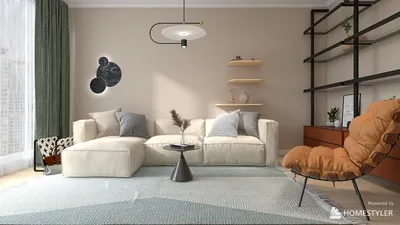


I once persuaded a client that a bold wingback chair would serve as the focal point for their 280 sq ft studio—however, the delivered piece resembled a sofa wrapped in a sleeping bag. This design misstep made it clear that selecting the right chair for a compact space is crucial, as it must be comfortable and appropriately sized. I like to start by visualizing these areas in 3D, which helps me understand how a chair's profile fits into the room.
1. Sleek lounge chair
I favor a sleek lounge chair featuring tapered legs because it appears light and airy in a small living area. It provides a proper lounge seat without overwhelming the space; however, be mindful that narrower armrests may not be suitable for those who enjoy sprawling out.
Tip: opting for a slightly taller back can maintain proportion, and a removable cushion simplifies cleaning.
save pin
2. Armless accent chair
Armless chairs are my preferred choice when pathways are tight—they easily slide alongside side tables and maintain sightlines. They surprisingly offer comfort if you select one with a rounded seat and good foam density, although some may miss the arm support.
Practical note: choose fabrics with higher abrasion resistance for daily usage in a small family room.
save pin
3. Convertible swivel chair
Swivel chairs are fantastic for tiny layouts: with a gentle turn, you can shift your view from the TV to the window or to a conversation. I’ve integrated them into numerous micro-apartments; just ensure you allocate some extra floor space for smooth rotation.
Budget tip: mid-range swivel mechanisms offer effortless movement without breaking the bank.
save pin
4. Stackable or foldable occasional chair
In multifunctional spaces, a stackable or foldable chair addresses the dual challenge of seating and storage. I once had a client who hosted weekly game nights—these chairs were invaluable. They might not be as plush as fixed lounge chairs, so consider pairing them with a cozy throw or seat pad.
Pro tip: store pads flat to maintain their spring and comfort for future use.
save pin
5. Compact armchair with slim arms
A compact armchair featuring slim, open arms provides the comfort of a traditional armchair without the bulk. I often recommend slim metal or wooden arms to keep the design airy, but note that you may have less surface area for resting drinks or remotes.
For cohesive tiny-home design centered on seating and layout, think about matching chair selections with space-efficient kitchen designs, particularly in multipurpose rooms—something I frequently explore during small open-plan projects using Homestyler.
save pin
Bonus setup tips
Select chairs with visible legs to enhance the sense of space, and arrange seating asymmetrically to produce visual interest. A small ottoman that can double as a coffee table is another trick I employ to maximize flexibility without needing extra chairs.
For the tech-savvy, I’ve tested layouts using AI-powered tools for tiny homes, which allow rapid experimentation with various chair layouts in limited spaces—this approach saves time and helps avoid the past mistakes I experienced with the wingback chair.
save pin
FAQ
Q1: What is the most comfortable chair type for very small living rooms?
A: Slim-profile lounge chairs and swivel chairs often manage to balance comfort with a compact footprint. Look for suitable seat depth (around 18–20 inches) and medium-firm cushions for daily comfort.
Q2: Are armless chairs comfortable for longer sitting?
A: Absolutely, provided they have sufficient seat padding and lumbar support. Adding a lumbar pillow can make armless options quite comfortable during prolonged use.
Q3: How do I select materials for small-space chairs?
A: Opt for fabrics that disguise wear (such as tweeds or performance weaves), and aim for finishes that keep the chair looking light, like slim metal or exposed wood legs.
Q4: Can a foldable chair be comfortable for guests?
A: Contemporary foldable chairs with contoured seats and foam pads can be surprisingly cozy; adding cushions can enhance comfort for extended gatherings.
Q5: How much clearance is needed around a swivel chair?
A: Ensure at least 6–12 inches of space behind the chair for it to rotate and move freely, depending on the size of the base and the range of swivel needed.
Q6: Is leather preferable to fabric in a small apartment?
A: Leather is simple to clean and offers a sleek appearance, but may feel warm in summer. Fabric brings warmth and texture; your choice should align with your lifestyle and maintenance preferences.
Q7: Are there ergonomic guidelines for chairs in small spaces?
A: Ideally, aim for a seat height of 16–19 inches for most adults, with seat depth allowing you to sit comfortably with feet flat on the ground. Keeping a gap of 2–4 inches from the seat edge to the back of your knees, and ensuring some lumbar support, reflects general ergonomic advice from health authorities, including Harvard Health Publishing (https://www.health.harvard.edu).
Q8: How can I test chair comfort prior to an online purchase?
A: Examine detailed dimensions, seek customer photographs, and reviews that note long-term comfort, and choose retailers with flexible return policies, allowing you to assess the chair’s comfort at home.
save pin
Homestyler's roots trace back to Autodesk, the global leader in design and engineering software. That heritage lives on in every feature we build. Today, with a community of more than 18 million users worldwide, Homestyler continues to make professional-quality interior design accessible to everyone — from first-time decorators to seasoned architects.
Looking to transform your home effortlessly? Homestyler is your go-to online design platform! With its user-friendly design tool, stunning 3D renderings, and a wealth of DIY video tutorials, you can easily create and visualize your dream space. Start designing today!
Projete agora para LIVRE
































