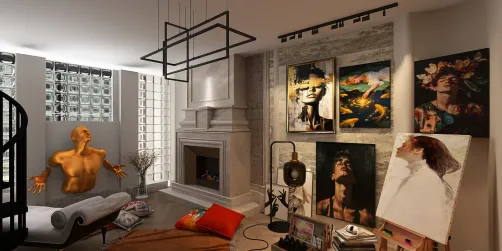
Art Corner Design
An art corner is a dedicated, intentionally curated zone within a residential interior—such as a living room, bedroom, or home office—that centers around the display, creation, or appreciation of visual art. Unlike generic wall decor, a well-designed art corner integrates artwork holistically with spatial elements: lighting, furniture layout, architectural features (e.g., windows, niches, or alcoves), and material textures. It serves both functional and emotional roles—acting as a creative sanctuary, a personal gallery, or a quiet reflective nook—while reinforcing the homeowner’s identity and aesthetic narrative. This scene transcends size or style constraints; it thrives in apartments and houses alike, and leverages tools like Homestyler AI design to simulate scale, lighting effects, and real-time 3D framing before physical installation.
Design Challenges & Common Pitfalls
Common challenges include visual clutter from mismatched frames or overcrowded walls, poor lighting that washes out color or creates glare, insufficient spatial breathing room leading to a cramped feel, and disconnection between artwork and surrounding furniture or architecture. Many designers also underestimate how scale, proportion, and eye-level alignment affect perception—especially in multi-functional spaces where the art corner must coexist with seating, storage, or circulation paths. Effective indoor space planning requires balancing artistic expression with ergonomic and environmental logic.
🎨 Strategic Visual Hierarchy
Prioritize one dominant focal artwork or cohesive grouping (e.g., triptych or themed series) to anchor the corner. Use size, contrast, and placement—centered at 57–60 inches from floor to center—to guide the eye naturally. Avoid symmetrical rigidity unless intentional; instead, apply the rule of thirds or asymmetric balance for dynamic energy. Homestyler AI design tools allow instant preview of composition variants, helping refine hierarchy without physical trial-and-error.

Daniela Schanglies’ bedroom design demonstrates strategic visual hierarchy by positioning a large framed artwork above a compact desk—creating a clear vertical axis amid layered textures (wood, linen, ceramic). Using Homestyler AI design tools, she simulated natural daylight from the adjacent window to ensure optimal color rendering and avoided glare on the canvas surface—an essential part of indoor space planning for art corners.
Start Free Design Now💡 Integrated Lighting Strategy
Lighting transforms passive display into experiential storytelling. Combine ambient (ceiling or recessed), task (adjustable wall sconces or picture lights), and accent (track or directional spotlights) layers. Prioritize CRI >90 and color temperature between 2700K–4000K for true-to-life pigment fidelity. Avoid overhead-only setups that cast harsh shadows or flatten depth. Homestyler AI design enables real-time photometric simulation—testing light falloff, hotspot spread, and shadow behavior across different fixture placements and times of day.

Amalia Osburn’s creative workspace uses focused LED picture lights angled precisely at a central canvas—enhancing texture and dimensionality without spilling onto adjacent shelves. Her Homestyler AI design workflow included toggling time-of-day presets to verify consistent visual impact under both artificial evening light and mixed daylight conditions—key to robust indoor space planning.
Begin Free Design Today🌿 Contextual Material & Spatial Harmony
Anchor artwork with complementary materials—not matching, but resonating: matte frames with raw wood shelves, metallic accents echoing brushed brass hardware, or organic shapes mirroring nearby potted plants. Maintain negative space (minimum 6–8 inches around frame edges) to prevent visual saturation. Ensure furniture scale supports rather than competes—e.g., low-profile seating allows unobstructed sightlines. Homestyler AI design tools let users drag-and-drop finishes, swap wall colors, and test material pairings instantly—streamlining contextual harmony decisions.

Ashley TT’s living room art corner achieves contextual harmony through rhythmic repetition: terracotta planters echo warm tones in the abstract painting, while the curved sofa back subtly mirrors the arched top of the frame. Leveraging Homestyler AI design, she adjusted wall finish opacity and tested three rug textures to confirm tactile cohesion—showcasing advanced Homestyler design techniques for holistic indoor space planning.
FAQ
Q: Can I create an art corner in a small apartment without making it feel crowded?
Yes—prioritize verticality (floor-to-ceiling shelving with integrated ledges), use mirrored or glass-front cabinets to preserve openness, and select one statement piece over multiple smaller ones. Homestyler AI design helps visualize spatial density before committing to layout.
Q: How does Homestyler AI Painter enhance art corner customization?
AI Painter generates unique, stylized artworks from uploaded images—and renders them as realistic 3D framed pieces inside your modeled space. You can iterate styles (watercolor, oil, line art), frame types, and lighting interactions instantly—making personalized art integration faster and more intuitive.
Q: What’s the most common indoor space planning mistake in art corners?
Hanging artwork too high or too low relative to seated or standing sightlines. The ideal center point is 57–60 inches from floor level—regardless of ceiling height. Homestyler AI design includes eye-level reference guides and real-time height measurement tools to prevent this error.
Q: Do I need professional lighting expertise to get good results?
No— Homestyler AI design includes built-in photometric presets (e.g., 'Gallery Mode', 'Warm Studio') that auto-adjust intensity, beam angle, and color temperature. You can further fine-tune using the lighting editor to match your art corner’s mood and function.

Canvas Wall Art - Open Window with Tuscany View

VibrantVisions Tree of Life Canvas Wall Art

HGUAOA Nature Wall Art - Mountain & Landscape
Homestyler offers an easy-to-use online design tool with stunning 3D renderings, a vast collection of interior design projects, and helpful DIY video tutorials. It’s ideal for anyone looking to create and visualize beautiful home designs effortlessly.
Projete agora para LIVRE