Art Corner Design
An art corner is a dedicated, intentionally curated zone within a residential interior—such as a living room, bedroom, study, or even a hallway—that centers visual art as both aesthetic anchor and emotional catalyst. Unlike generic wall decor, an art corner integrates artwork holistically with spatial elements: architecture (wall texture, moldings, ceiling height), lighting (directional, ambient, accent), furniture (scale, material, placement), and surrounding objects (plants, books, textiles). It transforms passive viewing into immersive experience—where a painting isn’t just hung, but *lives* in dialogue with light, shadow, and daily life. This concept aligns precisely with the 'My Art Corner at Home' challenge, where AI Painter enables users to generate bespoke, 3D-framed artworks that respond organically to real-world spatial conditions—making art not an afterthought, but a foundational layer of indoor space planning.
Design Challenges & Common Pitfalls
Creating a compelling art corner faces three recurring hurdles: (1) Visual imbalance—artwork overwhelmed by cluttered surroundings or competing focal points; (2) Spatial disconnection—framing, scale, or lighting that fails to harmonize with wall proportions, ceiling height, or adjacent furniture; and (3) Emotional dissonance—art style or subject matter that clashes with the room’s function or occupant’s narrative (e.g., an intense abstract piece in a calming bedroom). These issues often stem from treating art as decoration rather than spatial participant—a misstep that undermines holistic interior space planning.
✅ Prioritize Visual Hierarchy
A successful art corner must establish clear visual dominance without overwhelming the space. This means selecting one primary artwork (or a tightly composed group) as the undisputed focal point—and then deliberately minimizing competing elements: simplifying nearby furniture lines, reducing accessory density, and using neutral backdrops or recessed lighting to isolate the piece. Scale matters: artwork width should be 50–75% of the furniture it anchors (e.g., a sofa), and bottom edge ideally positioned 55–60 inches from floor for optimal eye-level engagement.

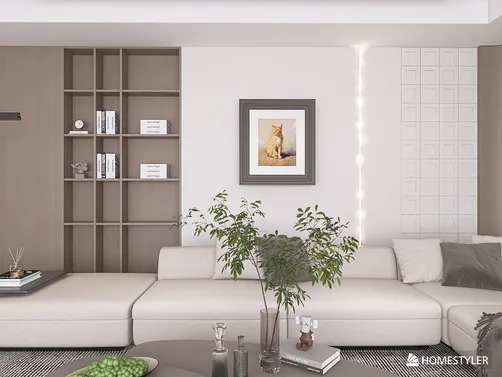
Isa Martinez’s 'Detalles de diseño que cuentan historias' exemplifies visual hierarchy: a single warm-toned abstract painting takes center stage above a low-profile sofa, flanked only by subtle wood-textured side tables and a single potted plant. Using Homestyler AI design tools, she generated a custom artwork whose earthy palette echoes the sofa’s fabric and wooden accents—reinforcing cohesion without visual noise. The nighttime HDR rendering ('wuhan_night') adds soft ambient glow, ensuring the art remains legible and emotionally resonant under low-light conditions—an intelligent application of indoor space planning.
Design Your Art Now💡 Integrate Lighting Strategically
Lighting is the silent curator of any art corner. Avoid flat, overhead illumination that flattens depth and washes out color. Instead, deploy focused, adjustable lighting—like picture lights or track heads—positioned at a 30° angle to minimize glare and maximize texture visibility. Layer this with ambient light (e.g., floor lamps or wall sconces) to prevent harsh contrast between art and surroundings. In dimmer zones (bedrooms, studies), consider LED-lit frames or backlighting for subtle halo effects—enhancing presence without compromising serenity.

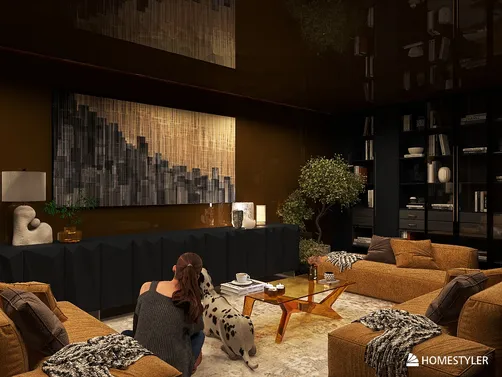
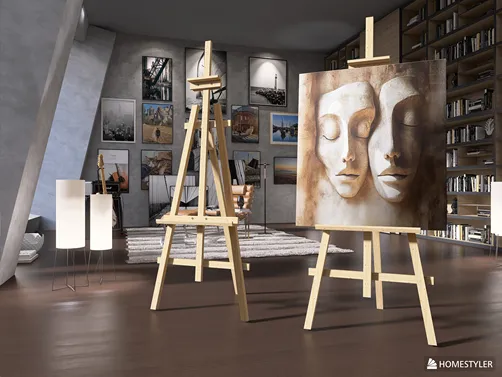
Beth M’s 'Chill Art Corner 🎧 🎶' demonstrates strategic lighting integration: a large framed mural hangs above a minimalist desk, illuminated by a focused downlight that creates gentle highlights on the canvas surface—while warm-toned desk and floor lamps provide balanced ambient fill. Using Homestyler’s daylight simulation ('g_ljz_day'), she tested multiple lighting angles virtually before finalizing placement—ensuring no hotspots or shadows disrupted the composition. This reflects advanced Homestyler design tips: treat lighting as part of the artwork’s form, not just its visibility.
Start Free Art Design🌱 Anchor Art with Contextual Elements
Art gains meaning when grounded in context—not just physical anchoring (e.g., to a wall), but semantic anchoring through complementary materials, textures, colors, and functional adjacencies. A nature-inspired print pairs naturally with live plants and raw wood furniture; a monochrome geometric piece resonates beside metallic finishes and crisp linens. Always ask: does this artwork *belong here*, or does it merely *hang here*? Contextual anchoring makes art feel inevitable—not imposed.

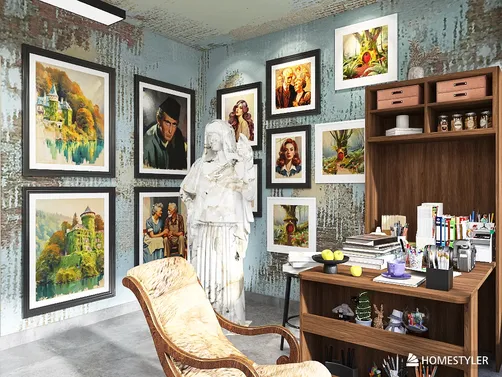
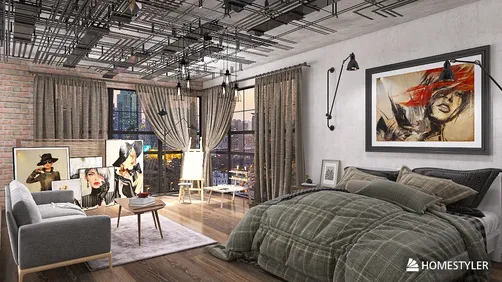
Coretta Wintz’s 'A Solitary Workspace' powerfully anchors art through context: a vibrant AI-generated mural—depicting bleeding watercolor textures—faces a weathered wooden desk stacked with open sketchbooks and analog tools. The mural’s chaotic energy mirrors the creative process, while its color palette subtly echoes the desk’s warm stain and the greenery on the windowsill. Leveraging Homestyler AI Painter, she uploaded a personal sketch as input, guiding the AI toward expressive imperfection—proving how AI tools can deepen narrative authenticity when aligned with contextual interior space planning.
FAQ
Q: Do I need prior design experience to join the My Art Corner challenge?
I don’t need prior experience! The challenge welcomes all skill levels. Homestyler AI Painter guides you step-by-step: upload any photo, select a style, and instantly generate a custom artwork + 3D frame. It’s designed for intuitive indoor space planning—even beginners can create professional-grade art corners in minutes.
Q: Can I use my own artwork—or is AI generation required?
You may upload your own image as input for AI Painter to stylize—or start fresh with AI-generated concepts. The tool enhances creativity, not replaces it. Your vision drives the process; AI refines execution—ideal for experimenting with Homestyler design tips across styles, scales, and spatial contexts.
Q: How does AI Painter ensure the artwork fits my actual room dimensions and lighting?
Homestyler AI Painter renders your artwork in true-to-scale 3D frames, compatible with your uploaded room layout. You can preview it under different HDR lighting conditions (e.g., 'wuhan_night', 'g_ljz_day') and adjust sun angle, intensity, and wall reflectivity—enabling precise indoor space planning before physical installation.
Q: Is there a limit to how many designs I can submit?
Each participant may submit up to 4 designs per contest (toolLimits: [4]), encouraging thoughtful iteration over quantity. Every registered user also receives one free AI Painter credit—perfect for testing ideas before final submission.
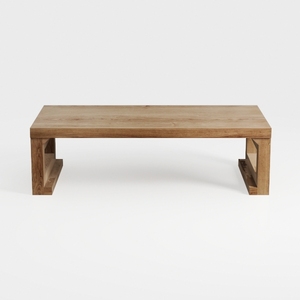
Bed Table Bed Desk Living Room Simple and Creative
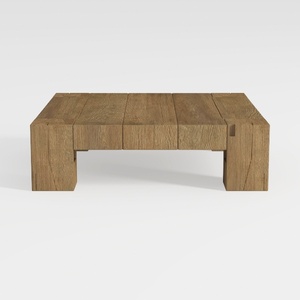
Rustic Solid Oak Wood Coffee Table Minimalist Living Room 3D Model
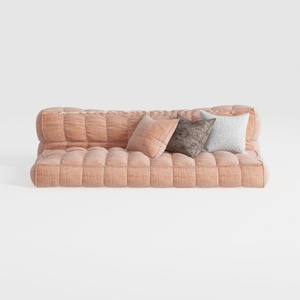

Minimalist Blush Fabric Tufted Contemporary Sofa 3D Model
Homestyler offers an easy-to-use online home design tool with stunning 3D renderings, a vast collection of interior design projects, and helpful DIY video tutorials. It’s perfect for bringing your creative ideas to life and making home design simple and fun.
Projete agora para LIVRE