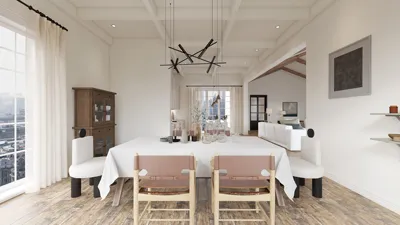


With over a decade of experience in interior design, I've observed how the rise of open-concept homes and adaptable living spaces has made L-shaped living rooms increasingly prevalent. These uniquely shaped areas often inspire innovative solutions, and I’ve discovered that with a thoughtful approach, an L-shaped room can exude both style and functionality. In this article, I will share ten captivating living room concepts for L-shaped layouts, combining my insights with expert advice, including how tools like Homestyler can aid in visualizing these ideas.
1. Define Zones Using Area Rugs
My Experience: In one particular client project, we utilized two distinct rugs to create a visual separation between the living and dining spaces, eliminating the need for walls. This instantly gave the L-shape a more intentional appearance.
Advantages: Area rugs contribute to spatial delineation and can subtly guide foot traffic, particularly in open-plan L-shaped designs. The proper rug size can help anchor furniture, enhancing the room's balance.
Disadvantages: In compact spaces, rugs can be challenging — if they are too large, they can overwhelm the area, while those that are too small might seem insignificant.
Tip: Always measure your space before making a purchase, and consider layering a smaller rug over a neutral foundation to add depth and texture.
2. Employ Sectional Sofas to Fit the Room
My Experience: Sectional sofas are essentially designed for L-shaped spaces. In my living area, an L-shaped sectional allowed for maximum seating while maintaining clear pathways — it felt custom-made for the room.
Advantages: Sectionals provide abundant seating and naturally complement the room’s shape. They are perfect for creating a cozy conversation area in one side of the L-shaped living room.
Disadvantages: Choosing an oversized model or dark-colored fabric in a smaller room may overwhelm the space.
Maximizing seating potential with a sectional is one of my top recommendations.
3. Consider Floating Furniture
My Experience: While working on a narrow L-shaped room, placing all furniture against the walls made it feel like a corridor. Floating a sofa and positioning a console behind it created a much more inviting atmosphere.
Advantages: This arrangement promotes better flow, avoids dead spaces, and allows light to be distributed more effectively. Floating furniture can also prevent the room from feeling cramped.
Disadvantages: Sufficient floor space is necessary; otherwise, movement may be hindered.
4. Design a Reading Nook in the Short Arm
My Experience: The short end of the L can serve as a great private area. In a previous project, I incorporated a chair, a small bookshelf, and a floor lamp, and it soon became the client's favorite spot.
Advantages: This transforms underutilized space into a functional area without significant investment. A reading nook can feel cozy and welcoming.
Disadvantages: If not adequately styled, it may come across as an afterthought rather than a well-designed feature.
5. Utilize a Consistent Color Scheme and Flooring
My Experience: Maintaining consistency in flooring and colors helps visually link the two arms of the L, creating an illusion of a more expansive room.
Advantages: A cohesive design minimizes visual clutter and improves light flow, which is essential in L-shaped living rooms.
Disadvantages: Excessive uniformity can be dull; incorporating accent pieces is necessary to inject personality.
6. Implement Glass Partitions or Sliding Panels
My Experience: In an urban apartment renovation, a glass partition allowed light to illuminate the space while subtly distinguishing the dining and lounge areas.
Advantages: These partitions maintain openness and bright surroundings; they can also adapt to changing needs.
Disadvantages: Glass requires regular cleaning and may necessitate safety reinforcement for durability.
For instance, glass panels can enhance the sense of openness, completely altering the perception of an L-shaped living room.
7. Create Built-In Storage Along One Wall
My Experience: Custom cabinetry is an excellent way to keep an L-shaped room organized. I designed a wall unit merging space for a TV, bookshelves, and concealed storage into one sleek design.
Advantages: This solution maximizes vertical storage, keeps floor areas clear, and can be customized to fit awkward corners.
Disadvantages: A built-in solution demands commitment, as it is not easily altered once installed.
8. Strategically Layer Lighting
My Experience: In a dim L-shaped room, implementing layered lighting that includes ceiling fixtures, floor lamps, and accent lights completely transformed the ambiance.
Advantages: This enhances functionality and mood, especially for multi-purpose rooms, and can spotlight specific areas.
Disadvantages: Additional fixtures can increase costs and require more upkeep.
9. Establish a Compact Home Office in One Segment
My Experience: Many clients today seek options for remote work. The shorter end of the L is often ideal for a small desk and ample lighting, creating a perfect work environment.
Advantages: It optimizes available space and can enhance property value, according to the 2023 Workspace Trends by Houzz.
Disadvantages: Attention to cable management is essential to avoid a cluttered appearance.
I’ve seen how dedicated workspaces can seamlessly integrate into an L-shaped living area without feeling intrusive. Homestyler can assist in visualizing the layout.
10. Feature Statement Artwork in the Transition Corner
My Experience: The internal corner of an L-shaped room often feels awkward; positioning a striking piece of artwork there can transform it into a focal point.
Advantages: It draws the eye and connects both sections of the room, adding character and charm.
Disadvantages: Large art pieces can be costly, and it's essential to ensure they are proportionate to the space.
Conclusion
Ultimately, having an L-shaped living room should not be perceived as a limitation, but rather as an opportunity for clever design. As noted by the design authority Apartment Therapy, the key lies in thinking in terms of zones and flow. Which of these suggestions would you be eager to try in your own L-shaped space?
Frequently Asked Questions
1. How can I make an L-shaped living room appear larger?
Utilize consistent flooring, lighter color schemes, and minimalistic furniture to create visual coherence.
2. What type of sofa is best for an L-shaped area?
An L-shaped sectional is ideal; however, combining a standard sofa with accent chairs can also offer flexibility.
3. How should I arrange furniture in the corner?
Transform the inside corner into a cozy reading nook or an artistic display, making it a standout feature.
4. Can I divide an L-shaped living room?
Yes, utilize rugs, partitions, or varied lighting to delineate zones without obstructing light.
5. Is an open plan beneficial for L-shaped rooms?
Open plans improve light flow, but it’s crucial to define areas to avoid a cluttered appearance.
6. How can I effectively use lighting in L-shaped layouts?
Layer lighting with ambient, task, and accent types to create a balanced and functional atmosphere.
7. Should both sections of the L feature the same design?
Maintain a cohesive base style but allow each section to incorporate distinct accents for added interest, as suggested by Elle Decor.
8. Can a home office be integrated into my L-shaped living room?
Absolutely, the shorter arm is often perfect for a stylish and compact workspace.
Discover the ease of home design with Homestyler! This fantastic platform offers an intuitive online design tool, stunning 3D renderings, and a wealth of inspiring design projects. Plus, with DIY video tutorials, you can confidently create your dream space—no experience necessary!
Projete agora para LIVRE
































