


Illusionary Living Space Design
The 'Illusionary Living Space' is a conceptual interior design scenario that transcends conventional spatial logic—inspired by the Homestyler 'Design or Deceive? April Fool’s Interiors' challenge. It prioritizes perceptual play over pure functionality: walls may dissolve into reflections, floors invert into ceilings, furniture defies gravity, and color, light, and materiality conspire to question what is real and what is rendered. This scene isn’t defined by room type (e.g., kitchen or bedroom) but by *intent*: to provoke wonder, disrupt habit, and transform domestic space into an experiential paradox. It demands intentional indoor space planning where every element serves dual roles—as both functional object and visual trickster—making it ideal for designers exploring AI-assisted creativity, spatial storytelling, and experimental Homestyler design techniques.
Design Challenges & Common Pitfalls
Designing illusionary spaces introduces unique complexities: spatial coherence can collapse under excessive distortion; visual tricks may compromise usability (e.g., mirrored floors hinder navigation); surreal color schemes risk overwhelming rather than delighting; and AI-generated renders sometimes misinterpret impossible geometries, resulting in physically inconsistent lighting or floating objects. Moreover, balancing novelty with comfort remains difficult—users must still feel at home, not unsettled. These challenges underscore why thoughtful indoor space planning and iterative refinement using Homestyler design tools are essential—not as shortcuts, but as collaborative partners in illusion-making.
✅ Principle 1: Anchor Illusion with Real-World Reference Points
Every illusion gains credibility through contrast. Introduce one or two highly realistic, tactile, or familiar elements—a weathered wooden coffee table, a potted fiddle-leaf fig, or warm ambient lighting—that ground the viewer. These anchors prevent cognitive overload and help the eye reconcile the impossible with the plausible. In Homestyler, use high-fidelity photorealistic models from the 'April Fool’s Model Collection' (e.g., natural wood textures or linen upholstery) to reinforce authenticity amid abstraction.

Cecilia Botha’s 'Design and Deceive: April folls day' masterfully applies this principle: her vivid mural (a hyper-realistic cityscape) and grounded grey sofa act as strong reference points against the dynamic, almost kinetic wall patterns and floating decor. Using Homestyler AI, she likely generated layered HDR environments ('g_riverside_street') to ensure lighting consistency across both real and illusory surfaces—demonstrating how indoor space planning benefits from AI’s ability to unify disparate visual logics.
Start Designing Free🌀 Principle 2: Manipulate Scale, Orientation & Gravity Strategically
Disrupt perception not randomly—but through deliberate inversion (ceiling-as-floor), scale exaggeration (oversized door handles on miniature walls), or ambiguous orientation (staircases without origin or destination). Crucially, maintain internal logic: if gravity reverses in one zone, reflect that consistently in shadow direction, object placement, and material behavior (e.g., rugs ‘falling’ upward). Homestyler’s rotate/flip tools and parametric model scaling enable precise control—turning conceptual absurdity into render-ready intention.

Cecilia Botha’s award-winning Top 1 entry employs subtle gravitational ambiguity: ceiling-mounted cushions appear weightless yet harmonize with downward-facing pendant lights—achievable in Homestyler by locking light-source vectors while rotating soft goods independently. Her indoor space planning ensures all inverted elements share the same vanishing point, preserving cohesion. This reflects advanced Homestyler design techniques: using sun-angle sync + manual model rotation to simulate controlled anti-gravity—not chaos.
Create Your Space Now🎨 Principle 3: Unify Surrealism Through Monochromatic or Harmonic Palettes
Surreal forms demand chromatic restraint. A monochrome base (e.g., charcoal, ivory, slate) or tightly curated analogous palette (teal–indigo–slate) prevents visual noise and focuses attention on form and paradox. Introduce one bold accent—like a single crimson cushion or neon-green plant—to act as a ‘perceptual reset button’, guiding the eye and reinforcing compositional hierarchy. Homestyler’s color-scheme generator and material-swapping shortcuts make rapid palette iteration effortless—even for high-concept illusionary living spaces.

Graca Doutel’s 'Ascending Into a Dream: The Spiral Paradox' exemplifies this principle: a strict monochrome palette (white walls, grey staircase, translucent glass) makes the central spiral structure read simultaneously as architecture and optical illusion. She leveraged Homestyler’s material library to assign identical reflectivity values to staircase metal and floor glass—ensuring seamless blending. Her indoor space planning prioritizes tonal unity over texture variety, proving that Homestyler design techniques thrive when surrealism is disciplined, not decorative.
FAQ
Q: Do I need professional 3D modeling skills to enter the 'Design or Deceive' challenge?
Not at all. Homestyler’s AI-powered interface allows beginners to generate high-fidelity illusionary scenes using text prompts, drag-and-drop model libraries (like the April Fool’s Model Collection), and one-click lighting presets—making advanced indoor space planning accessible without CAD expertise.
Q: Can I combine real-world constraints (e.g., door locations, window sizes) with illusionary elements?
Absolutely—and it’s encouraged. The strongest entries honor architectural reality as a springboard for illusion. Use Homestyler’s precise measurement tools and floorplan import feature to lock structural elements first, then layer surreal interventions (floating shelves, mirrored ceilings) atop them—ensuring your design feels both magical and buildable.
Q: How does Homestyler AI handle 'impossible' geometry like infinite staircases or inverted rooms?
Homestyler doesn’t auto-generate true paradoxes—but its rendering engine excels at *suggesting* impossibility through clever perspective, reflection, and lighting. For example, use mirrored floor materials + upside-down furniture models + directional shadows to imply inversion. The key is strategic suggestion—not literal violation—making Homestyler design techniques uniquely suited to illusionary living space concepts.
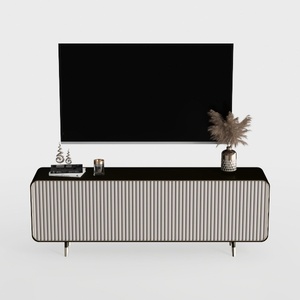
Modern Fluted Solid Wood Metal TV Stand Console Table 3D Model
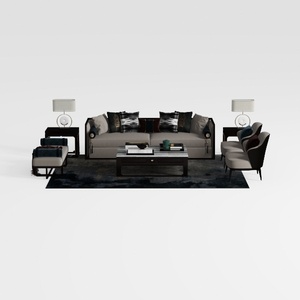
Modern Fabric Wood Living Room Furniture Set Sofa Chairs Coffee Table Lamps 3D Model

Modern Black Leather Gold Legged 3 Seat Sofa 3D Model
Homestyler offers an easy-to-use online design tool with stunning 3D renderings, inspiring interior projects, and helpful DIY video tutorials—perfect for turning your home design ideas into reality effortlessly.
Projete agora para LIVRE





