As urban living continues to evolve, homes are becoming increasingly streamlined, challenging clients to face issues like noise transmission, storage limitations, and fluid movement within spaces. Utilizing a spatial reasoning toolkit, I analyze the floor plan of Vyom Block 2 Part 1 Flat C, aware that modern living requires optimized signals and minimal friction. Research from the AIA indicates that homes featuring adaptable spaces yield greater satisfaction among residents, while insights from Zillow reveal that clarity in layout is more valuable than mere square footage. Therefore, I approach this plan akin to programming code tailored for the future.
Hybrid Spine with Split Day/Night
Design Logic: A central spine effectively delineates between communal and private areas, catering to needs for both work and restful sleep. The trend is shifting towards versatile spaces rather than rigid walls.
Flow: The design leads from the entryway to a small foyer, progressing into a combined living and dining area that flows into the kitchen, with the spine continuing towards the bedrooms and culminating at the bathroom to minimize noise transfer.
Sightlines: The elongated layout provides an unobstructed visual path in the living area; a partial view of the kitchen enriches the experience while the bedrooms are discreetly hidden until needed.
Storage: Features like custom millwork in the foyer serve as efficient storage solutions; wall-mounted storage along the spine maximizes space while ensuring easy access, with a spacious pantry situated close to the kitchen.
Furniture Fit: The design accommodates a sofa measuring 36-38" in depth against the spine, a dining table sized at 72" x 36", and bedroom wardrobes designed as 24" modules—integrating seamlessly without disrupting movement patterns.
Verdict: This layout protects against noise infiltrations and fosters an environment conducive to concentrated work without compromising family interaction.
save pinOpen in 3D Planner Processing...
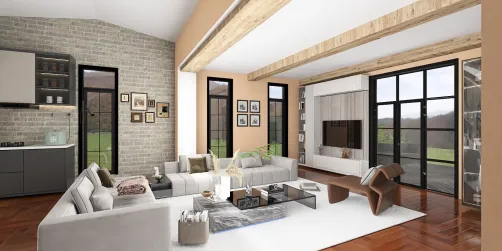
Corner Living with Diagonal Signal
Design Logic: A diagonal visual pathway from the entrance to the window alleviates tension and enhances the sense of space, particularly vital in densely populated urban settings.
Flow: From the entry point to an angled console, the living area is oriented towards corner light, flowing into a loop back to the kitchen, while bedrooms are accessed through a perpendicular corridor to create a calming pace.
Sightlines: The diagonal line of sight to the glazing acts as the primary user interface, complemented by secondary elements like an art wall and a kitchen pass-through, with a gradient of privacy escalating along the corridor.
Storage: The angled console incorporates a concealed shoe storage; a media wall with vertical accents enhances functionality, while a linen bank in the corridor serves as an efficient buffer system.
Furniture Fit: A sectional sofa with a chaise measuring between 96 and 108" follows the diagonal, complemented by a compact round table measuring Ø42"; the queen-sized beds allow for 30" of clearance on each side to maintain an uninterrupted flow.
Verdict: This diagonal strategy promotes spatial efficiency—boosting natural light and decreasing transition time—creating evenings that feel more expansive and work sessions that are calmer.
save pinOpen in 3D Planner Processing...
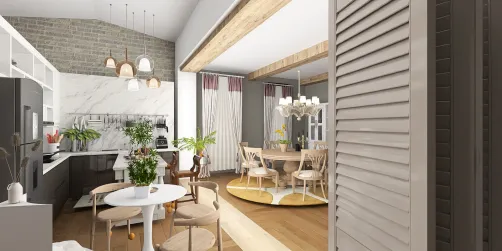
Kitchen as Command Module
Design Logic: Envision the kitchen as a command center that adeptly manages meal preparations, work tasks, and social gatherings; future homes will require multifunctional nodes.
Flow: The layout features a U-shaped preparation area with a quick shift to the dining section, returning to the living space, while a parallel branch leads to a utility balcony that contains noise and heat away from the central areas.
Sightlines: Low kitchen counters promote visibility across rooms; a tall pantry serves as a functional display wall, keeping clutter hidden while indicating usability.
Storage: A pantry with a depth of 24" includes labeled bins; toe-kick drawers cater to less frequently used tools; overhead storage is designed to be only 15" deep to limit visual bulk—creating cache without chaos.
Furniture Fit: Counter stools are designed with a 24" seat height and a 12" overhang; the dining table measures between 70 and 74", with slim chairs 18" wide to maintain fluidity in the command flow.
Verdict: A kitchen designed as a command module stabilizes everyday routines; it effectively synchronizes nutrition, workflow, and family interactions.
save pinOpen in 3D Planner Processing...
Final Takeaway
The floor plan of Vyom Block 2 Part 1 Flat C is akin to a compact operating system: clearly defined day/night zones, diagonal visuals enhancing communication, and a kitchen command center orchestrating everyday activities. As urban density increases, the layout's functionality becomes paramount over mere space; a carefully curated apartment design beats sheer square footage. Through my experience, I foresee future homes becoming not larger in size but more intentionally designed, a philosophy that is clearly embodied in this plan, which could also benefit from tools like Homestyler for better visualization.

Discover the creativity of home design with Homestyler! This user-friendly online platform offers a fantastic design tool, stunning 3D renderings, and a wealth of DIY video tutorials. Perfect for both pros and beginners, you can easily transform your living space into a stylish haven.