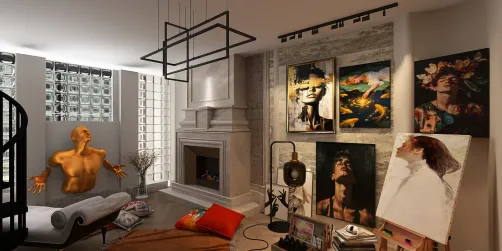
Art Corner Design
An art corner is a dedicated, intentionally curated zone within a residential interior—such as a living room, bedroom, hallway, or even a compact nook—that centers around visual expression, personal storytelling, and aesthetic engagement. Unlike generic wall decor, a well-designed art corner integrates artwork *spatially*: it considers scale, lighting, furniture adjacency, sightlines, material harmony, and emotional resonance. It transforms passive display into active spatial dialogue—where framed pieces, sculptural objects, creative tools, greenery, and ambient light coexist to form a cohesive micro-environment. This scene is highly adaptable across dwelling types (apartments, houses, studios) and user profiles (artists, collectors, families, remote workers), making it a cornerstone of contemporary indoor space planning.
Design Challenges & Common Pitfalls
Common challenges include visual clutter from overcrowded walls, poor lighting that flattens texture and color depth, mismatched frame scales disrupting rhythm, artwork placed too high or low relative to eye level and furniture, and neglecting how the corner interacts with adjacent functional zones (e.g., blocking circulation or competing with a TV wall). Many designers also underestimate the role of negative space—leaving insufficient breathing room around pieces—or fail to anchor the corner with supporting elements like a console, shelf, or accent rug, resulting in a disconnected, 'pasted-on' effect rather than an integrated part of the interior narrative.
✅ Strategic Visual Hierarchy
Establish a clear focal point—typically one dominant artwork or a tightly composed triptych—and layer supporting elements (smaller frames, objects, plants) at diminishing visual weight. Use size, contrast, saturation, and placement to guide the eye naturally from primary to secondary to tertiary elements. Avoid symmetry overload; instead, apply the rule of thirds or golden ratio for organic balance.

Nory Garcia’s 'Art Corner' exemplifies strategic visual hierarchy: a large vertical canvas above the sofa serves as the undisputed anchor, flanked by two smaller horizontal pieces at calibrated heights. She leverages Homestyler AI design tools to simulate lighting angles—ensuring the pendant lamp casts gentle, focused illumination on the central piece without glare—while maintaining consistent frame finishes and spacing to reinforce rhythm. This reflects intentional indoor space planning where every element supports, rather than competes with, the core visual story.
Start Free Design🎨 Thoughtful Spatial Integration
Treat the art corner not as isolated decoration but as architecture-in-miniature. Align artwork baselines with furniture tops (e.g., sofa backrest), center groupings over consoles or sideboards, and maintain proportional relationships between wall area and artwork coverage (e.g., 60–70% of wall width for a gallery wall). Consider traffic flow, sightlines from key vantage points (entryway, seating), and how adjacent surfaces (windows, shelves, doors) frame or interact with the display.

Daniela Schanglies’ design demonstrates thoughtful spatial integration: the trio of artworks is precisely centered over a low-profile console aligned with the sofa’s front edge, creating a unified horizontal band. Using Homestyler AI design tools, she tested multiple layout iterations against real-time room dimensions and window placements—ensuring the composition remains legible from both seated and standing positions while leaving generous negative space above and beside the grouping. This approach embodies intelligent indoor space planning that respects human scale and movement.
Begin Free Design💡 Contextual Lighting & Material Harmony
Lighting must enhance—not flatten—artwork. Prioritize adjustable directional sources (picture lights, track heads, or well-placed floor lamps) over diffuse overheads. Coordinate frame materials (wood, metal, acrylic) and finish tones with nearby furniture, hardware, and flooring. Introduce tactile contrast through complementary textures: matte frames with glossy art prints, woven baskets beneath framed sketches, or velvet stools beside minimalist canvases.

VIKI V’s 'creative space' near stairs uses a focused table lamp to spotlight a medium-sized canvas above a writing desk, while natural light from the adjacent window adds dimensionality to textured paper and plant foliage. With Homestyler AI design tools, she simulated different bulb color temperatures (2700K vs. 3000K) and shadow fall-off to optimize depth perception—then matched the walnut frame tone to the desk’s veneer and the ceramic planter’s glaze. This holistic use of light and material harmony elevates the art corner beyond decoration into experiential interior design.
FAQ
Q: Can I create a compelling art corner in a small apartment without major renovation?
Yes—absolutely. Focus on vertical real estate (a narrow wall beside a door or above a sofa), use floating shelves for layered displays, and choose one bold statement piece instead of many small ones. Homestyler design tips emphasize scaling artwork to wall height (e.g., 50–60% of wall height for a single piece) and using mirrors or glossy finishes to amplify perceived space—key principles in effective indoor space planning.
Q: How does Homestyler’s AI Painter enhance art corner design compared to manual selection?
AI Painter generates stylistically cohesive artwork *from your own photos*, ensuring emotional authenticity and color harmony with existing décor. It auto-generates realistic 3D framed previews in your exact room model—letting you test scale, finish, and lighting interaction before committing. This bridges conceptual vision and spatial execution, a core advantage of modern Homestyler design techniques.
Q: What’s the most common mistake when integrating art into multifunctional spaces (e.g., living-dining hybrids)?
The top error is treating the art corner as a standalone island. Instead, align its visual weight and orientation with the dominant function: e.g., orient a vertical gallery toward the seating zone, not the dining table. Use shared materials (same wood tone in frames and dining chairs) or a unifying color accent to bind zones—a fundamental strategy in professional indoor space planning.


Homestyler offers an easy-to-use online home design tool with stunning 3D renderings, inspiring design projects, and helpful DIY video tutorials. It’s perfect for bringing your interior decoration ideas to life quickly and beautifully.
Projete agora para LIVRE