


In today’s tech-savvy lifestyle, devices like the Oura Ring 5 are revolutionizing how we monitor our health and wellbeing right from home. Integrating such advanced wearables inspires new ways to design living spaces that promote relaxation and recovery. Thoughtfully arranged furniture and calming environments can complement the data-driven insights these gadgets provide, creating a harmonious blend of technology and comfort in your personal sanctuary.
Direct Answer
The optimal small living room piano layouts position the piano along a wall, in corners, or transitional spaces, allowing it to serve both as a musical instrument and a visual focal point. Emphasize clear pathways, space-saving seating, and versatile furniture pieces. Upright pianos generally suit compact rooms better than grand pianos, preserving floor area while delivering an impactful design statement.
Quick Takeaways
Introduction
Arranging a piano in a small living room is a common challenge encountered in interior design projects. Many homeowners believe that the piano must either dominate the space or that it simply won't fit. After designing multiple cozy apartments and townhouses, especially in urban settings, it’s clear that the problem isn’t the piano itself but rather the layout approach.
Small living rooms often fail because their furniture arrangements neglect circulation paths, sightlines, and acoustic factors. Addressing these elements enables a piano to enrich the environment, lending sophistication without overcrowding. This guide explores practical layout strategies that successfully harmonize piano placement in confined areas.
Why Do Most Small Living Room With Piano Layouts Fail
Key Insight: The primary reason layouts falter is prioritizing furniture placement over natural movement flows.
In compact interiors, navigability is more valuable than square footage. Without clear walking routes, spaces feel cramped irrespective of their dimensions.
Common pitfalls include:
Research from the National Kitchen & Bath Association recommends residential circulation aisles remain between 30 and 36 inches wide. Many piano layouts in tight rooms inadvertently reduce this to less than 20 inches, impacting functionality.
How To Place A Piano In A Small Living Room Without Wasting Space
Key Insight: Positioning the piano parallel to a wall consistently enhances both spatial efficiency and aesthetics.
Nearly every small-scale design I’ve created shows that wall alignment makes the room feel more open and organized.
Three placements are especially effective: against a solid wall, tucked in a corner, or along a transitional area between zones.
Walls also serve acoustical purposes by reflecting sound into the room instead of dissipating it, improving the instrument’s tonal presence during informal performances.
Should You Choose An Upright Or Baby Grand For A Small Living Room
Key Insight: Upright pianos typically outperform baby grand models in rooms smaller than approximately 250 square feet.
This choice balances aesthetic preferences with practical space considerations. While many desire a baby grand’s elegance, it frequently complicates spatial layouts in compact settings.
I often advise clients that unless the piano is intended as a dramatic centerpiece within a generous open floor plan, an upright piano integrates effortlessly into small living rooms.
What Furniture Arrangement Works Best Around A Piano
Key Insight: Successful layouts treat the piano as a secondary design element rather than the primary seating focus.
A common mistake is orienting all seating toward the piano, whereas living rooms generally need to facilitate conversation, media viewing, and relaxation.
Effective arrangements create dual zones: a conversational seating cluster and a dedicated musical nook, enhancing the room’s function without overcrowding.
Hidden Design Tricks That Make A Piano Feel Built In
Key Insight: Visually integrating the piano with adjacent furniture enlarges the perceived space.
Professional styling involves blending the piano into the room’s overall composition instead of isolating it as an independent object.
Techniques such as adding tall artwork or shelving above the piano establish vertical balance, preventing the room from feeling bottom-heavy.
Answer Box
The most effective small living room with piano layout positions an upright piano against a wall or in a corner, maintains at least 30 inches of clear circulation path, and arranges seating primarily around the conversational zone. When designed thoughtfully, the piano emerges as a cohesive element rather than a space-consuming barrier, and tools like Homestyler can help visualize and plan these configurations.
Final Summary
FAQ
Can a piano fit in a small living room?
Absolutely. Upright pianos comfortably fit in spaces as small as 120 to 150 square feet when placed along a wall.
What is the best position for a piano in a living room?
Positioning the piano against a solid wall, away from direct sunlight and heating elements, protects it and optimizes room layout.
How much space do you need around a piano?
Ideally, allow 30 to 36 inches for a clear walking path and at least 24 inches for the bench area.
Is a baby grand piano too big for a small living room?
Frequently, yes. Baby grand pianos usually require considerably more floor depth than uprights.
Can a piano go in the corner of a living room?
Yes. Corner placement is often one of the smartest solutions for including a piano in a small living room.
Should the sofa face the piano?
Not necessarily. Most layouts function better when seating centers on the conversation area rather than facing the piano.
Does a piano make a small room look crowded?
Only if circulation routes are obstructed. Proper planning can make the space feel more structured and inviting.
How do you decorate around a piano?
Incorporate wall art, a piano lamp, and matching furniture materials to harmonize the piano with the room’s style, which can be effectively planned using Homestyler’s tools.

Minimalist Fabric U Shaped Sectional Sofa 3D Model
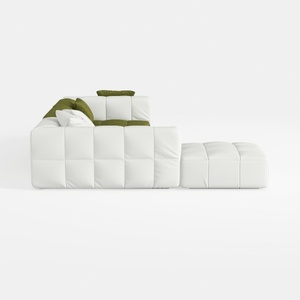
Minimalist White Fabric Tufted L Shape Sectional Sofa with Ottoman 3D Model

Minimalist Boucle Fabric Loveseat Sofa with Throw Pillows 3D Model
Homestyler offers an easy-to-use online home design tool with stunning 3D renderings, inspiring design projects, and helpful video tutorials. It’s perfect for anyone looking to create and visualize beautiful interior spaces effortlessly. Give your home a fresh new look today!
Projete agora para LIVRE
































