


AI-Enhanced Small-Space Living Room Design
The AIDA Global AI Design Awards spotlight innovative, human-centered interior solutions—particularly those that maximize functionality and emotional resonance in compact urban dwellings. From the winning entries, a recurring high-impact scenario emerges: the multifunctional small-space living room. This is not merely a scaled-down lounge—it’s a hybrid zone for working, relaxing, socializing, and even sleeping, often within apartments under 40 sqm. Winning designs (e.g., Rosi Stamile’s 'Vivienda de un solo ambiente, multifuncional' and FLOWER amri’s modern farmhouse bedroom-living fusion) demonstrate how AI-powered spatial intelligence transforms constraints into opportunities—optimizing sightlines, layering zones without walls, and personalizing atmosphere through dynamic lighting and adaptive furniture layouts. This scenario embodies the competition’s core mission: using Homestyler’s AI tools to turn abstract lifestyle desires—'calm', 'romance', 'freedom'—into spatially coherent, technically executable, and emotionally immersive interior space planning.
Design Challenges and Common Pitfalls
Small-space living rooms face three interlocking challenges: (1) Spatial ambiguity—blurred boundaries between living, sleeping, and working zones lead to visual clutter and functional friction; (2) Scale misalignment—oversized furniture or monolithic storage overwhelms proportion and kills flow; (3) Sensory overload—poor lighting layering, inconsistent material palettes, or excessive decor erode the sense of calm essential for compact wellness. Many amateur attempts rely on 'minimalist austerity' as a default, neglecting warmth and personality—precisely what the AIDA winners counter with strategic richness: curated textures, intentional negative space, and AI-optimized light simulation that enhances perceived volume.
✅ Prioritize Zoning Through Vertical Layering
Instead of physical partitions, define activity zones using vertical hierarchy: elevated desk surfaces, recessed ceiling lights for work, lowered pendant fixtures over seating, and floor-to-ceiling shelving that doubles as visual buffer and display. This leverages height—often the most underutilized dimension in small apartments—while preserving open-floor perception. Homestyler’s AI Smart Layout and real-time 3D rendering let designers instantly test sightlines, headroom clearance, and shadow patterns across multiple configurations.
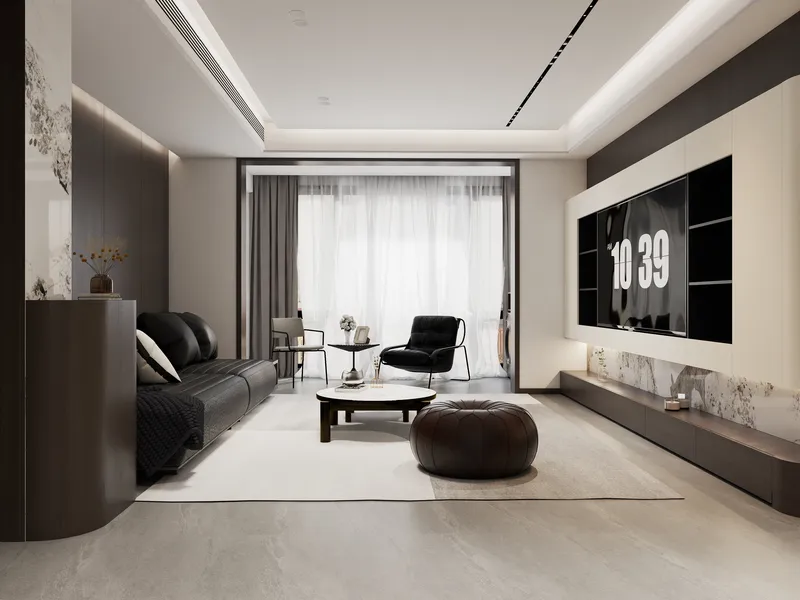
Designer Dapu (authorName: '设计师大瀑') applies this principle masterfully in 'Leng Jing Pai' ('Calm Style'). The compact layout uses a raised oak desktop integrated into a wall-mounted shelf unit—creating a distinct home office nook without encroaching on circulation. Below, a low-profile sofa and floating coffee table maintain visual continuity with the adjacent dining zone. Using Homestyler’s AI lighting render, they simulated soft ambient uplighting along the shelf base and focused task light over the desk—proving how vertical layering, enhanced by AI design tools, resolves zoning conflicts while reinforcing calm, a core theme in interior space planning.
Start Free Design🎨 Curate a Cohesive Material & Color Narrative
In tight spaces, every surface contributes to the psychological impression. Winners avoid generic 'neutral palettes' in favor of intentional, limited-material storytelling: e.g., warm-toned wood + matte black metal + tactile linen. Color is deployed strategically—not as wall coverage, but as accent bands (on shelves, baseboards, or furniture frames) that guide the eye and unify disparate functions. Homestyler’s AI Color Match tool enables rapid iteration of hue/value/saturation combinations against real-time rendered materials, ensuring harmony before physical procurement.
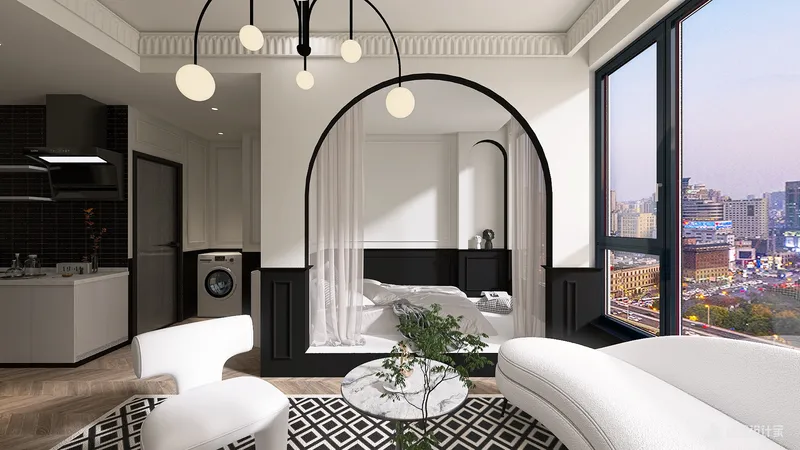
Raylene’s award-nominated 'CoCo. Camellia Scent' uses a refined Chanel-inspired palette: ivory plaster walls, blackened steel shelving, and blush-pink velvet upholstery—all tied together by repeated camellia motifs in textile and art. Crucially, Homestyler’s AI Render engine allowed precise simulation of how natural light from the large window would shift the perceived warmth of the pink across daylight hours, validating the color narrative’s emotional consistency. This exemplifies advanced Homestyler design techniques: moving beyond static swatches to dynamic, context-aware material validation.
Begin Free Design💡 Maximize Perceived Volume with Light & Reflection
Perceived spaciousness hinges less on square meters than on light distribution and reflective continuity. Winners deploy mirrored panels behind lighting, glossy floor finishes, glass-top tables, and strategically placed LED strips to bounce light deep into corners. AI tools are indispensable here: Homestyler’s AI Lighting Simulation calculates lux levels, glare indices, and shadow density—enabling designers to place indirect light sources that eliminate dark zones without adding visual weight. This transforms interior space planning from guesswork into evidence-based environmental engineering.

Rosi Stamile’s 'Single-Space, Multifunctional Dwelling' achieves remarkable airiness in a studio apartment by integrating a full-height mirrored wardrobe panel opposite the window—doubling natural light and visually extending depth. Homestyler’s AI Rendering was used to test 5 mirror placement scenarios, confirming that a 1.8m tall vertical strip (not full wall) delivered optimal brightness without sacrificing warmth. Her use of AI demonstrates how Homestyler design techniques empower data-informed decisions that elevate both aesthetics and livability in constrained environments.
FAQ
Q: What AI tools from Homestyler are most critical for small-space living room design?
Homestyler’s AI Smart Layout, AI Lighting Simulation, and AI Color Match are foundational. Smart Layout auto-generates space-efficient furniture arrangements based on room dimensions and user-defined priorities (e.g., 'maximize walkway width' or 'prioritize desk ergonomics'). Lighting Simulation predicts real-world illumination quality, and Color Match ensures material harmony across surfaces—key for avoiding visual chaos in tight quarters.
Q: Can AI really help me choose furniture that fits both physically and aesthetically in a small living room?
Absolutely. Homestyler’s AI doesn’t just check dimensions—it analyzes proportions relative to ceiling height, window placement, and adjacent zones. It cross-references your selected sofa with thousands of real product models, suggesting alternatives that match scale, style, and function (e.g., 'sofa with hidden storage + reversible chaise')—making interior space planning faster, more accurate, and highly personalized.
Q: How do AIDA-winning designers use AI to solve the 'too many functions, too little space' problem?
They use AI as a co-strategist: inputting lifestyle goals (e.g., 'work remotely 3 days/week, host 4 guests monthly'), then leveraging Homestyler’s AI to generate multi-scenario renders—showing how one modular sofa system can transform from lounge mode to guest bed mode, or how a fold-down desk integrates seamlessly into a bookshelf. This turns abstract needs into tangible, tested spatial solutions.

Minimalist Fabric Oversized Sofa 3D Model

Modern Dark Green Velvet Tufted L-shaped Sectional Sofa 3D Model
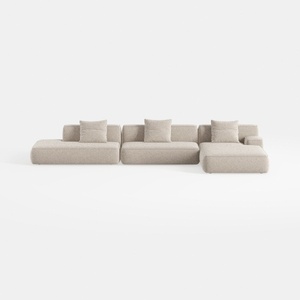
Minimalist Boucle Fabric L Shaped Sectional Sofa 3D Model
Homestyler offers an easy-to-use online design tool, stunning 3D renderings, and a rich collection of interior decoration projects. Plus, its DIY video tutorials make creating your perfect home design simple and enjoyable, whether you're a beginner or a seasoned designer.
Projete agora para LIVRE